Nay Pyi Taw November 30
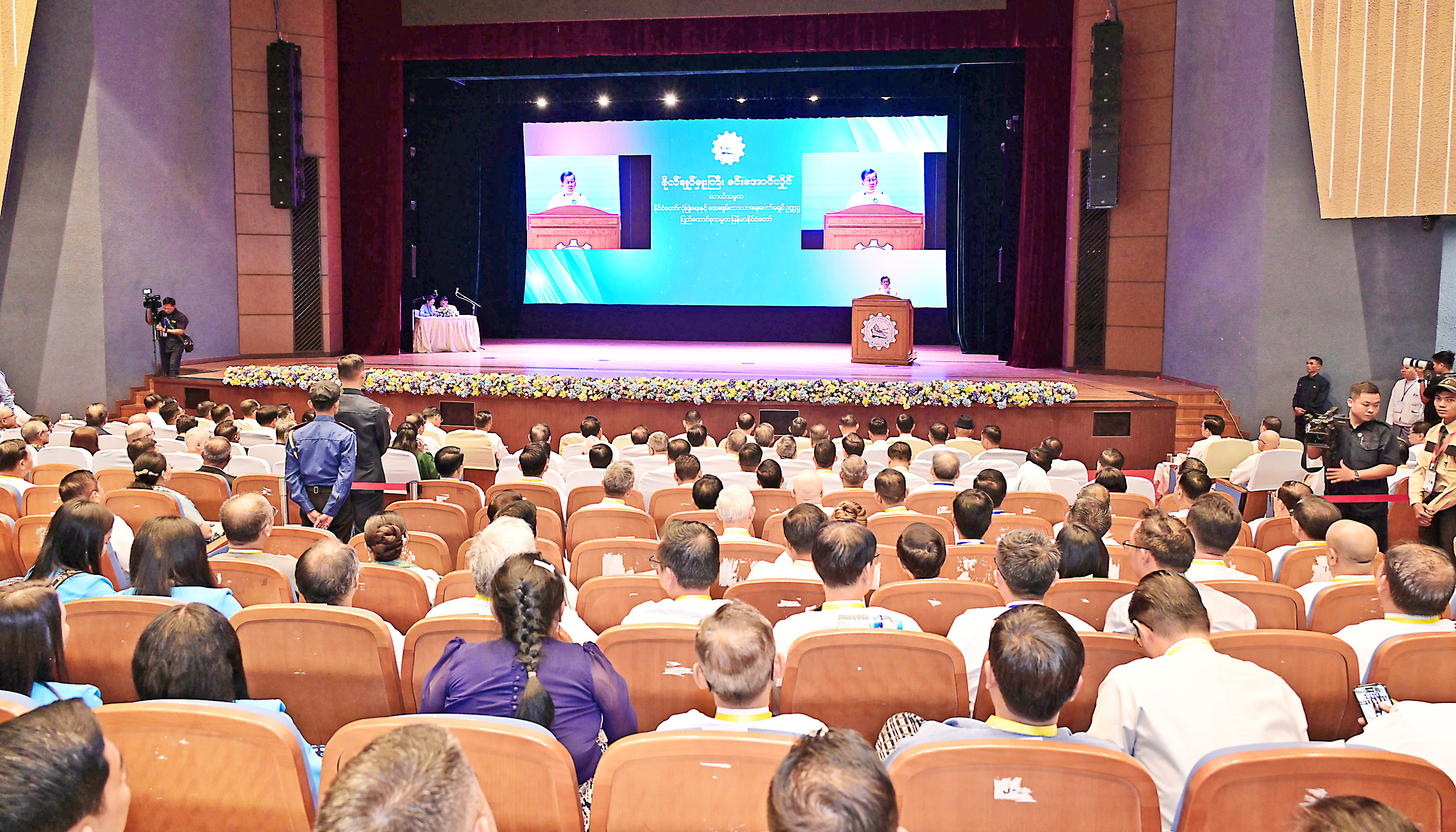
Union of Myanmar Federation of Chambers of Commerce and Industry held its 34th annual plenary session at National Theatre in Yangon this afternoon, addressed by Acting President of the Republic of the Union of Myanmar, Chairman of State Security and Peace Commission,Senior General Min Aung Hlaing.
Also present at the meeting were SSPC Secretary Joint Executive Chief General Ye Win Oo, union ministers, senior military officers from the Office of the Commander-in-Chief, the Yangon Region Chief Minister, the Yangon Command commander, deputy ministers, officials of UMFCCI, executive committee members, affiliated associations, diplo-mats, partners organizations, UMFCCI members and officials.
In his address, the Senior General expressed pleasure to meet all the UMFCCI members at the 34th annual plenary session of the federation, honouring and recognizing its ongoing efforts for the progress of private sector.
He said initially, it was founded in 1919 by patriotic nationality traders as ‘‘the Burmese Chamber of Commerce,’’ with the conviction that “only a robust economy can ensure national sustainability.” In 1999, it was reformed as UMFCCI, with the participation of affiliated associations that represented the relevant sectors. In addition to its over 100 years of existence, it is a National Apex Organization, recognized by the successive governments as the main partner organization.
In realizing the objective of the National Defence and Security Council “To ensure development of the agriculture sector, which plays vital role in the national economy, the growth of socio-economic life of the people will be achieved through the development of Agro-based industries” included in its four objectives, the efforts of private entrepreneurs in cooperation with the relevant ministries is important, and additionally, the involvement UMFCCI and its affiliated association also plays the pivotal role in this matter. The relevant organizations and associations are making collective efforts for national economic development through export promotion.
As the progress of the production industry is important in promoting the national economy, apart from trade, the government is providing support and encouragement to improve the quality and quantity of local products for export substitution. As the UMFCCI is formed not only with entrepreneurs representing the trade sector, but also with involvement of the production entrepreneurs, it should exert more energy for production development.
The accomplishment of the UMFCCI in acquiring new friendly trade partners in the international business area is important for national economic development and the progress of the private sector, and this achievement is helpful for enhancing the entire private sector to reach the global level through the emergence of entrepreneurs with the ability to compete in the international markets. At the time when other countries are showing interest in Myanmar’s geoeconomic opportunities, UMFCCI should strive to stand shoulder to shoulder with the international partner organizations and local associations.
Regarding the adoption of economic policies, the government is implementing them only after assessing the policies and guidelines that align with the prevailing changes. The understanding and cooperation of the private sector plays a vital role in successfully implementing the adopted policies and work programs. The government is always ready to overcome hard-ships and solve the problems private entrepreneurs face in practically materializing the policies and work programs. The private entrepreneurs should represent the majority in presenting their problems, policy suggestions sector wise. Only then will the government be able to look into the matter through necessary coordination.
In providing encouragement and support for national prosperity, domestic food sufficiency, MSME development, the State will exert efforts for ensuring cooperation between the government and the private sector, market development, acquiring new markets and market extension in accord with the section 35, which states, “The economic system of the Union is market economy system,” of the Chapter I of the 2008 Constitution.
The role of private sector will increase and become more important in the future business environment. So, priority must be given to seek means to operate the national economy based on the basic facts of the country and to operate regional economy based on its specific situations through discussions as it was mentioned at ‘‘the centenary of Myanmar economics’’.
He emphasized that the UMFCCI, as the national-level non-governmental leading organization representing the interests of private businesses, needs to actively cooperate and participate on behalf of the private sector in matters concerning the State’s future policies, work processes, advice, technologies, current challenges, and priority issues, relevant to each sector and field. He urged that since the State-formed commissions and committees include executive members from the Federation; they should work towards the nation’s economic development by offering beneficial suggestions and presentations from private sector entrepreneurs. Finally, he wished to convey that the affiliated associations representing various sectors and fields should also work together in unity and harmony under the leadership of the Federation of Chambers of Commerce and Industry.
He stated that the government and the private sector are mutually dependent and are working together to realize the nation’s economic interests, noting that the private sector is a key driving force in the economic development of any country. He emphasized that greater harmony between the government and the private sector can be achieved by effectively implementing work processes—starting from the existing dialogue forums that bridge the government and the private sector—until tangible results emerge in the nation’s development and public service sectors.
He observed that the attendance of officials from the State Government, international embassies, and international partner organizations at today’s Meeting of the Union of Myanmar Federation of Chambers of Commerce and Industry reflects the robustness and credibility of Myanmar’s private sector. He affirmed that foreign investments play an essential and vital role in striving for Myanmar’s long-term sustainable and inclusive economic development by strengthening domestic economic sectors, creating employment opportunities, and facilitating the transfer of new technologies and good international business practices. He concluded by expressing his belief that international friends and partner organizations will be able to continue intensifying their cooperation in establishing a mutually beneficial investment environment in Myanmar.
He concluded by urging the attendees to continue cooperating with the State and striving for the nation’s economic progress and prosperity for many years to come, reaching its golden and diamond jubilees, and to contribute exponentially to the development of the nation by becoming a robust, stable, and developed private sector.
The Senior General then gave supplementary remarks, stating that a nation’s wealth is measured by its GDP, which is calculated using the agricultural, industrial, and service sectors, and noted that Myanmar’s GDP remains weak. He emphasized that the agricultural sector is fundamental in Myanmar, and through the development of this sector, industry and services will also progress; since approximately 50 percent of the nation’s population earns its livelihood from agriculture, prioritizing and promoting the agricultural sector will lead to the advancement of other economic sectors.
Regarding trade, he mentioned the categories of manufactured goods, above ground and under-ground resources, and garment products, and emphasized that in utilizing resources, they should focus on those that are renewable, such as the production of timber and bamboo, and aquatic products. He pointed out that export goods are only possible when there are produced goods, and that one of the three slogans set by the State is “Let us encourage production for prosperity of the Nation.” Therefore, he stressed the need to promote production to enhance the nation’s economy.
He stated that the nation’s agricultural production remains weak, and if the target goals for cultivation are met, there will be an additional US$-8 billion income annually, and through multiple cropping, there will be approximately US$-12 billion more in earnings. He emphasized that by increasing production and exporting the goods, the nation would secure sufficient foreign currency, and therefore, he urged all to collectively strive to increase productivity.
Regarding the garment industry, he stated that it also needs to be further developed, noting that a United Nations report indicates that 46 percent of the nation’s population is on the poverty list, which is primarily calculated based on the economy of the rural population. Therefore, he stressed the need to increase the yield of agricultural products to boost the economy of the rural population, which would lead to an improved economy and higher living standards for rural residents, resulting in better supply and demand. He urged industrialists to collectively assist in elevating the rural economy and the living standards of the people there.
He observed that there are weaknesses in some areas regarding trade tax and affirmed that they are making every effort to optimize the trade tax system. He also stated that they have systematically managed foreign currency since they first took responsibility, and that there are plans to reduce tax rates soon. He assured that they are striving to achieve the best outcome for the nation’s economy, while simultaneously urging the Union of Myanmar Federation of Chambers of Commerce and Industry to conduct their businesses with honesty and integrity.
He stated that there is a need to work toward further progress in agriculture and livestock, increase the per-acre yields, and cultivate high-value crops, noting that Paw San Hmwe rice and coffee already have international markets. He urged all to collectively strive to produce goods that can secure foreign markets, emphasizing that the UMFCCI represents the entire country and can drive national economic development. Therefore, he stressed the imperative to increase production and conduct business with integrity, asking that when producing and selling goods, they ensure correct pricing and guarantee the quality of the products. He highlighted that reducing poverty within the country is a matter of national dignity, and thus, all must cooperate to elevate the national economy to satisfy this requirement, primarily by increasing public purchasing power. He explained that by increasing the production of goods, supply and demand will become balanced, which will allow for the control of high commodity prices, and he stressed the need to sell essential goods for the public’s livelihood at correct prices.
He concluded by asserting that the nation will only develop when its economy is sound, and therefore, everyone must cooperate to enhance the economy by increasing productivity.
Subsequently, the President of the UMFCCI delivered a welcoming speech. Following that, the General Secretary read and presented the 2024-2025 Annual Report and Financial Statement.

Then, the Senior General, along with the guests and executive members of the UMFCCI, took a group commemorative photograph.
The report concluded that the Senior General and his delegation, then proceeded to tour and encourage each of the exhibition booths displayed at the 34th annual plenary session of the UMFCCI.