Nay Pyi Taw December 5
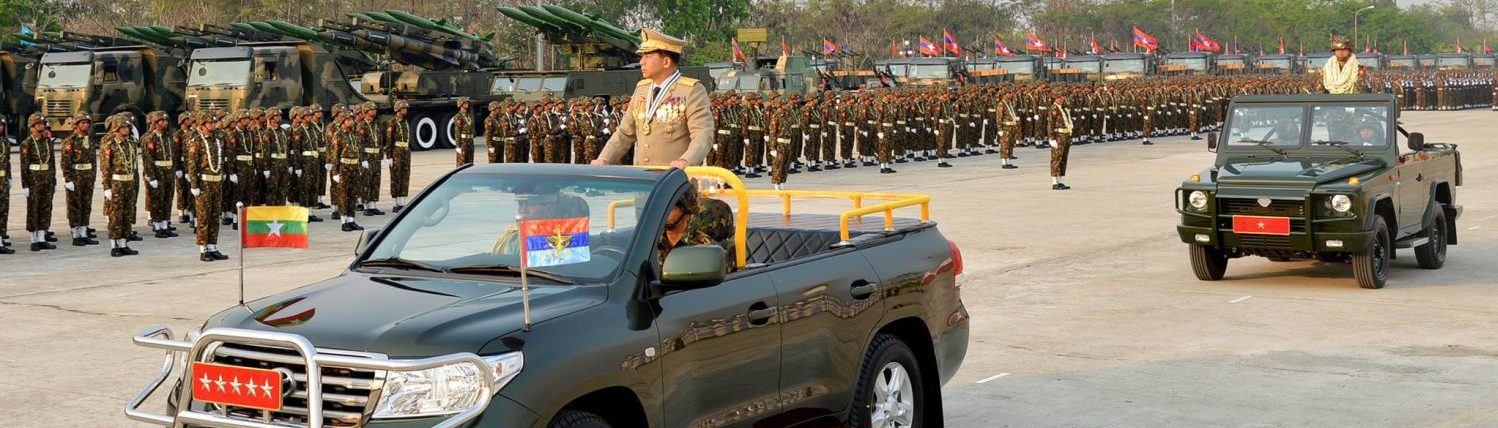
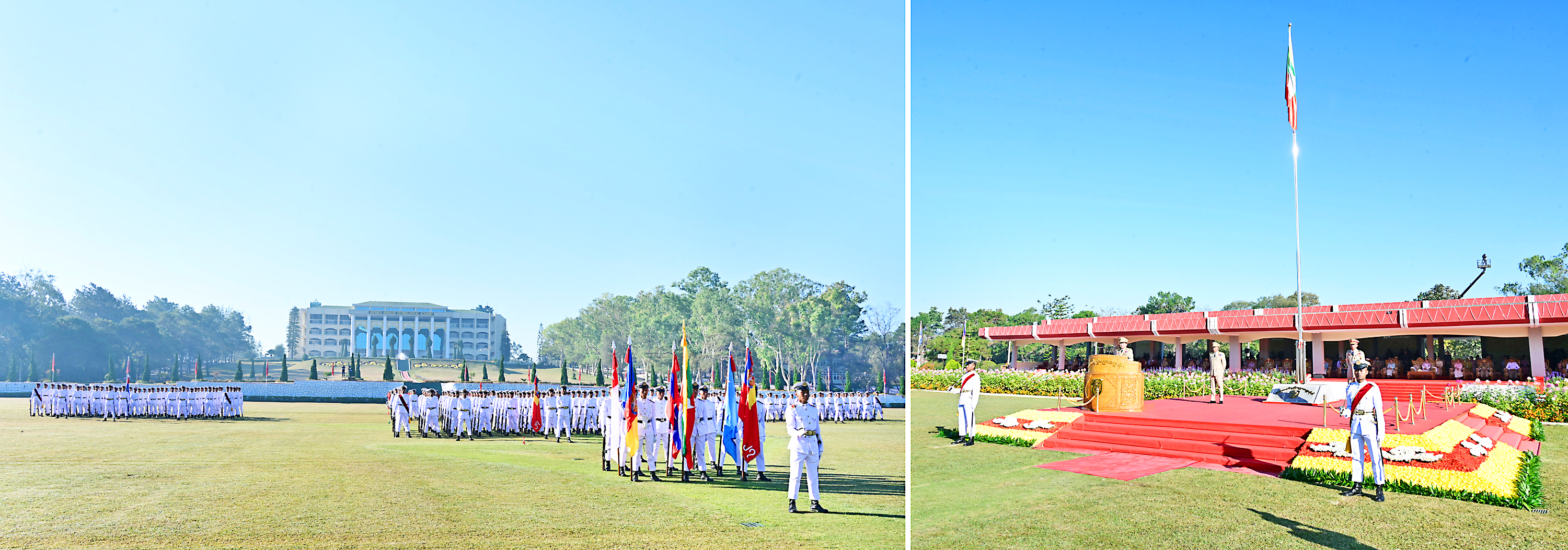
The Passing-out Parade of the 27th Intake of Defence Services Technological Academy was held at the parade ground of DSTA in PyinOoLwin this morning with an address by Chair-man of State Security and Peace Commission Commander-in-Chief of Defence Services Senior General Thadoe Maha Thray Sithu Thadoe Thiri Thudhamma Min Aung Hlaing.
Also present at the ceremony together with the Senior Gene-ral were wife Daw Kyu Kyu Hla, Commander-in-Chief (Navy) Admiral Zeya Kyawhtin Htein Win and wife, Commander-in-Chief (Air) General Zeya Kyawhtin Sithu Tun Aung and wife, senior military officers from the Office of the Commander-in-Chief and wives, Union level dignitaries, Union ministers and wives, the Mandalay Region chief minister, military command command-ers, the DSTA commandant, officials from PyinOoLwin Station, families and relatives of cadets and guests.

First, the Senior General took the salute of cadet companies and inspected them. Then, the cadet companies saluted the Senior General with slow-march past and quick-march past.
The Senior General presented Best Cadet Award to Cadet No. 8487 Cadet Nyan Lin Htet, Excellent Award in Training to Cadet No. 8536 Cadet Arkar Phyo, and Excellent Award in Studies to Cadet No. 8480 Cadet Swan Htet Aung.
In his graduation ceremony address, the Senior General said today is the passing out parade of the 27th Intake of the Defence Services Technological Academy. It is an auspicious day for our Tatmadaw, as it brings renewed strength to the engineering sector. In accordance with the objective of the Defence Services Technological Academy “To produce under-graduate, postgraduate, and graduate engineering officers who are fully qualified for the Tatmadaw (Army, Navy and Air )” you have been systematica-lly taught and trained through-out the entire course, not only in engineering disciplines but also in military science and leadership, up to the level of an Infantry Platoon Commander.
The Corps of Military Engine-ers has long stood as a reliable and indispensable supporting arm of the Myanmar Tatmadaw, its history closely intertwined with the Tatmadaw’s struggle for national independence. Throughout successive eras, it has consistently provided strong and dedicated engineering support to the various units and formations of the Tatmadaw (Army, Navy and Air) up to the present day. The Corps of Engin-eers has effectively carried out its assigned objectives: the three main tasks of the Tatmadaw, “To Move, To Fight, and To Live.” In addition to its vital role in military operations, the Corps has also contributed significantly to the nation’s development by undertaking the construction of administrative buildings, essential public service facilities, and major and minor industrial and commercial infrastructure, as well as repairing and main-taining roads and bridges to ensure uninterrupted trans-portation. Therefore, as you prepare to become members of the Corps of Engineers, you must be ready not only to engage in combat like infantry soldiers but also to master both your military engineering disciplines and the principles of military strategy. At the same time, you must strive to become techni-cally proficient engineers capable of performing, with de-dication and effectiveness, the national development duties.
When we look at the conflicts occurring in the world today, we see that the former pattern of threats centered on nuclear weapons and conventional armaments has now shifted toward technology-driven types of warfare. Powerful nations have begun forming blocs, using smaller and weaker countries as intermediaries, and attempting in various ways to control the influential neigh-bouring countries of those small nations. Due to rapid techno-logical advancements, concepts of military strategy, the structure of warfare, the scope and nature of battles, and the conduct of military operations have all evolved progressively from one stage to another. We can observe the development of weapon systems capable of gathering, calculating, and integrating information and numerical data to deliver precise strikes, as well as the increasing use of integrated command systems and information-network systems. Proficiency in military strategy, superiority in air power, advancement in electronic technology, and improvements in weapons and ammunition particularly their effe-ctiveness and precision have become decisive factors deter-mining the outcome of modern warfare.
In contemporary conflicts, the use of drones has also ex-panded alongside technological advancement. Therefore, it is necessary to have a thorough understanding of drone and counter-drone strategies, to be able to employ them effectively, and to continue advancing technological capacity without interruption. I urge you, com-rades, to continuously study the scientific and technological developments occurring in military affairs around the world. In doing so, you must strive to innovate and create in accordance with the motto of the Defence Services Techno-logical Academy: “Honour, Creative, Capable” so that you may contribute effectively to our nation and our Tatmadaw.
Due to the rapid advancement of modern military science and technology, contemporary war-fare has now progressed to the point where artificial intelligence (AI) systems, rather than human operators, are increasingly being used to lead, coor-dinate, and control operations.
By employing AI systems in warfare, it becomes possible to collect real-time information, thereby enabling effective su-rveillance of enemy movements. One of the most critical appli-cations of artificial intelligence (AI) is in cybersecurity. With AI, cyberattacks can be detected swiftly and countered in a timely manner, thereby enhancing the security of military networks to the highest possible level. Therefore, I urge you, comrades, to continuously study and learn the engineering technologies that are advancing in line with the times, as well as the military strategies and operational doctrines that are evolving along-side them. In doing so, you must remain committed to the motto “Study, Practice, Follow” and strive to acquire these skills ceaselessly.
In addition to fulfilling national defence duties, our Tat-madaw has also been able to successfully perform humanitarian assistance and disaster-relief operations responding swiftly to natural disasters, which pose grave threats to humanity. As a national respon-sibility, we have effectively carried out rescue and relief operations during such emergencies. Following the recent Mandalay earthquake in our country, the Tatmadaw actively participated in clearing debris, reopening and repairing trans-portation routes as quickly as possible, and dismantling and removing unsafe structures. Thereafter, we also took part vigorously in recovery and reconstruction efforts.
Although natural disasters cannot be entirely avoided, preparedness and preventive measures must be carried out for the future. In constructing earthquake-resistant buildings, it is essential to view the process from an engineering perspec-tive and adhere to established engineering standards to ensure resilience against seismic ha-zards.
In the construction of the Maravijaya Buddha Image, earthquake resistance, wind-impact endurance, and protection against various natural hazards were systematically calculated and incorporated from the very beginning of the project to ensure long-term stability. As a result, when the recent major Mandalay earth-quake occurred, both the Image and the main platform remained completely undamaged. This demonstrates that engineer-ing designs which proactively consider natural hazards earth-quakes included and follow proper engineering standards ensure long-lasting durability.
During natural disasters, you must provide rescue assistance promptly, without waiting for further orders, whenever knowledge and capability allow. At the same time, you must main-tain readiness in manpower, machinery, and technological support to be able to effectively contribute to emergency response and disaster-relief operations.
As you are about to serve as junior military engineering leaders of the Tatmadaw, you must possess both competence and integrity, and you must be able to provide correct and principled leadership to the subordinates under your command.As future leaders, it is essen-tial that you uphold good moral character and sound discipline.
As future junior leaders of the Corps of Engineers, you must act in accordance with the sixteen leadership attributes, uphold good moral discipline, set an example in obedience to commands and regulations, fulfil assigned duties with full capability and success, and command your subordinates with the mindset of a good leader and a fatherly spirit. By doing so, your subordinates will regard you as trustworthy leaders, and your superiors will recognize you as capable and dependable junior comman-ders. Therefore, I urge you to strive to become exemplary and admirable leaders.
In order for our Tatmadaw to successfully fulfill its primary duty of national defence, every soldier must possess the five fundamental qualities: “Spirit, Discipline, Loyalty, Unity, and Ability the threefold comple-teness.” To build a strong and capable armed force grounded in these qualities, we must im-plement the four major pillars of force development: Training, Administration, Welfare, and Morale.
In terms of training, faithfully carrying out one’s daily duties is itself a form of training. It is necessary to strictly supervise and ensure that all individual and collective physical training exercises, conducted daily, weekly, and monthly, are carried out correctly and consistently.
By living, practising, and train-ing in a manner befitting a good soldier, each individual must strive to improve both personal capabilities and the proficiency of their unit.
As the Tatmadaw operates under a hierarchical command system, a fair and uniform ad-ministration must be maintained. If every soldier maintains strict discipline and if admini-strative support is properly provided, morale will naturally strengthen. Therefore, it is essential to uphold good, fair, and consistent administration. Those in command must lead their subordinates with the mindset of a responsible leader and caring guardian, guiding them with genuine goodwill and dedication.
The Tatmadaw ensures that soldiers at every rank receive the entitlements and benefits appropriate to their level. There-fore, commanders must super-vise to ensure that all personnel receive their rightful benefits fully and correctly. In addition, commanders should assist their subordinates with personal difficulties wherever possible. By managing one’s income and expenditures prudently, each individual can achieve personal welfare and wellbeing.
Only when leaders at every level possess strong morale and discipline will the soldiers under them also develop the same qualities, resulting in units with strong combat capability and effectiveness. The four major pillars of force development are interconnected: when training is conducted properly, admini-stration is fair and efficient, and welfare is adequately provided, soldiers and their families will develop a strong sense of belonging to their units, loyalty and trust in the Tatmadaw, and a willingness to sacrifice for the Tatmadaw and the nation. Therefore, I urge you that upon joining the respective battalions or units to which you are assigned you must strive to successfully implement these four major pillars of force development.
As the multi-party democratic general election will commence on 28 December, all national ethnic citizens must work colle-ctively to ensure its successful conduct. According to the his-torical development of our country and the demands of the present era, the aspiration and objective of the State and the majority of the people is to establish a Union founded on a de-mocratic system and a federal system. To reach this goal as swiftly as possible, it is essential that the multi-party democratic system remains active and functioning. Therefore, the Tatmadaw is ensuring that the nation does not deviate from the path of a multi-party democratic system. Since sustaining a multi-party democratic system requires the continuous implemen-tation of elections, the govern-ment is making preparations from multiple angles to ensure that the upcoming election is free, transparent, and fair, and one that is held with dignity. The Tatmadaw, for its part, is also supporting the vitality of the multi-party democratic system which is necessary for the emergence of a Union based on democracy and federalism and is actively cooperating to ensure the success of the 2025 multi-party democratic general election.
An election marks a critical turning point for the transfor-mation of the State’s admini-strative mechanism. Therefore, it is necessary for the election to be free, transparent, and fair, and for the representatives chosen by the people to be individuals of capability and integrity. To ensure that the people can correctly choose their representatives, I urge you, comrades, to study the relevant electoral laws and pro-cedures, and to organize and encourage all eligible voters within your respective assigned areas to exercise their voting rights.
As the engineering sector plays a vital role in building the Tatmadaw into a modern force, you must strive, in accordance with the guiding motto of the Defence Services Technological Academy “Honour, Creative, Capable” to become knowle-dgeable and skilled professio-nals upon whom the State and the Tatmadaw can firmly rely. As junior military engineering leaders, you must conduct yourselves in accordance with the 16 leadership attributes, maintain good moral character, set an example in obedience to orders and discipline, and carry out the duties assigned to you with full competency and success. You must endeavor to become capable junior leaders who can shoulder every res-ponsibility entrusted to you. In the multi-party democratic general election, in addition to organizing for all eligible voters to cast their votes, you must also ensure that no acts of disruption occur within your assigned areas and that security measures are carried out systematically. By doing so, you will collectively contribute to the successful and orderly conduct of the election.
After taking the salute from the cadet companies, the Senior General left the parade ceremony.
After the parade ceremony, the Senior General met with the cadets, who won outstanding awards, and their parents and relatives at the parlour of the headquarters of the DSTA and spoke words of honour.
In his praise of the outstanding cadets, the Senior General said their outstanding achievements and awards are acknow-ledged and praised with joy together with their parents and relatives. They won the outstanding awards deservin-gly because of their efforts throughout six years of the course in their educational and military lessons and self-control. The good foundations and the ability to control their mind they had gained throughout the course must be further streng-thened. At the academy, they had to learn technological knowledge, in addition to aca-demic knowledge, and as they were taught valuable sciences, they must continue their efforts to never lose sight of their vision and goals. They must serve the national interest with their professional and technological knowledge. They must always be aware of the era that is see-ing rapid technological advances through constant studies, research and efforts. Apart from learning intellectual knowledge and general know-ledge, they must also share their knowledge with their subordinates and youths of the areas they are serving duties.
Everyone wants a successful life, and it must be built with the continuous efforts to maintain life visions and the ability to live and work systematically. They must be good subordinates as well as good leaders in serving their duties.
They must always understand and need to pay back the debt of gratitude they owe to their parents who had nurtured and protected them since their childhood days. Moreover, they must be loyal to the Tatmadaw that had trained them to be disciplined in every action and to gain intellectual and techno-logical knowledge. They must continue their effort throughout their life for the successful realization of their goals and maintain their families’ goals. Through the continuous efforts, they should try to have self-control and to become reliable leaders for the family, Tatmadaw and State.