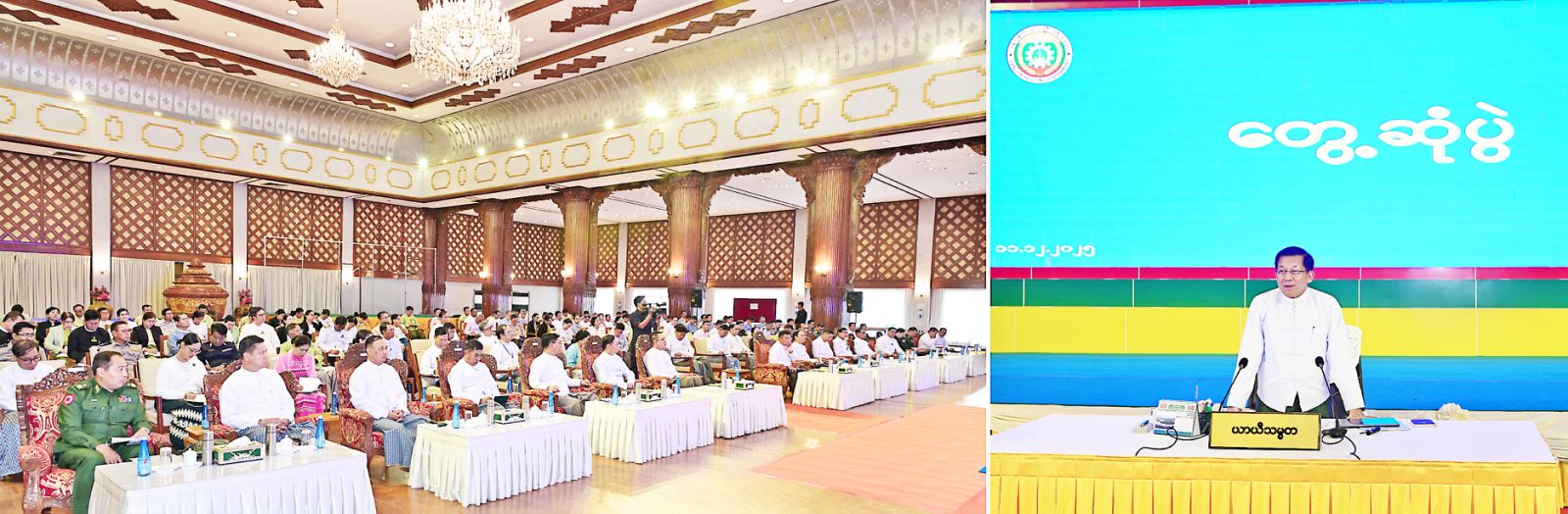
Nay Pyi Taw December 11
Acting President of the Republic of the Union of Myanmar, Chairman of State Security and Peace Commission, Senior General Min Aung Hlaing met members of Yangon Region government and region and district level departmental officials at Mingala Hall of the region government office this afternoon, and discussed regional development.
Also present at the meeting were SSPC Secretary Joint Executive Chief General Ye Win Oo, members of the entourage, the Yangon Region chief minister, the Yangon Command commander, deputy ministers.
Report on ongoing regional development undertakings
First, the chief minister reported on points of the region, agricultural undertakings, storage capacities of dams, pumping and storing water with solar power and electricity, rural electrification through the use of solar power, loans from national economic development funds for progress of farming, local and foreign investments and job opportunities, MSME development undertakings, promotion of education, health and sports sectors, endeavours for the successful holding of multi-party democracy general election, systematization of pol-ling stations, and guaranteeing the rights of eligible voters, and canvassing campaigns of political parties in Yangon Region.
Clarifications of Union ministers in connection with the report
Regarding the report, union ministers, Dr Thet Khaing Win and Dr Soe Win, stressed the collective participation of administrative officials in carrying out public healthcare activities, apart from health staff, pointing out the serious efforts of the State in giving vaccines to expectant mothers and infants, which is an important task. They also discussed the availability of financial support for elderly care services, natural disaster risk reduction undertakings, and building a disaster resilience country.
Know the region’s basic facts correctly, apply them effectively
Regarding the reports, the Senior General said the country will hold the multi-party democracy general election on 28 this month, and a government change will occur at the end of March 2026. A Union report on the 2024 population and housing census had already been issued. The report includes valuable statistics, numbers and data for the nation. The collected information discloses the daily lifestyles that spotlights demographic changes and rural and urban populations, education level of the citizens, the size of labour force and employment, migration and the way of life. Hence, policymakers, planners, data users must effectively use the said information. Likewise, departmental personnel of Yangon Region too must pay attention to the census report for the development of their region.
Investing in education regarded an investment in the country’s future
Collected figures and data indicate the weakness in the country’s education sector. The government in office is encouraging education promotion activities in all seriousness. Efforts must be made to increase in student class attendance and to maintain the number of students from the lower to higher grades, but weakness is found in the anti-student attrition projects. Yangon Region should strive to reduce student attrition rate, as weakness in the education sector can be followed by the weakness in the remaining sectors. Human resources imbued with intellectual knowledge and technological knowledge must be generated in building a modern nation in the future. In addition, a disciplined and orderly society must be materialized, and as the saying goes, “Discipline starts at schools” children of the future must obey the teachings of their teachers. Children who have attended school have better discipline than the ones who have never attended school, and morale and discipline of children improve together with the rise in grades. In addition, they can acquire decent behavior, way of life and habits, and a moral sense to stay away from smoking, drinking and betel chewing that are unbeneficial for them and the society. Students can be turned into a valuable generation of youths with good morale and discipline through systematic schooling. The State Government is enhancing edu-cation promotion activities in all seriousness as investing in education is investing in the nation’s future. Schools will hold the final examinations in February 2026. Hence, they must make preparations to ensure full participation in the examinations and a resurge in the number of students from lower to higher grades in the coming year.
Promoting production based on agriculture and livestock businesses
Regarding agriculture and livestock, he stated that it’s necessary to increase production activities to ensure food sufficiency for the people residing in the Yangon Region. He stated that reasonably priced food commodities will only be achieved if sufficient meat, fish, and eggs required by urban residents are produced and sold. He noted that if consumption and production are balanced, the high cost of goods can be reasonably contained. He emphasized the need to utilize the vacant and virgin lands in Yangon City for agricultural and livestock production, strive for regional food security, and ensure food supply is adequate for people of all social classes to consume.
He noted that Myanmar, under successive previous governments, experienced trade deficits and relied on non-trade earnings and grants to cover necessary foreign currency expenditures. These trade deficits were caused by weak production; only through domestic production can export goods be generated, leading to trade surpluses. Therefore, he stated that since taking charge, they have promoted production and supported domestic manufacturing. However, because they couldn’t achieve full implementation, the expected revenue wasn’t fully realized. He concluded that if they can achieve the production targets, they’ll be able to increase production in agriculture-based industries. He stated that there are many agricultural and livestock experts in the Yangon Region, so it’s essential to utilize these experts effectively to meet the region’s needs. He noted that official data shows significant variations in agricultural output in the country across different eras, and that accurate data and statistics are crucial for better analysis and execution of national development efforts. Therefore, he urged those executing the projects to strive to meet the target goals and instructed those responsible for collecting statistics to ensure the accuracy of the data. He stressed that, fundamentally, everyone must genuinely work for the development of the country, and that the necessary resources will be provided to enable this work.
Also, he stated that if agricultural and livestock businesses develop, the socio-economic lives of farmers will also improve, and the resulting increase in local circulating capital will, in turn, lead to regional development. Therefore, he emphasized that they must work to develop pro-duction based on agriculture and livestock businesses, and strive for the development of the agricultural, industrial, and service sectors. He stressed the need to encourage the development of CMP and MSME businesses and particularly focus on MSME production based on raw materials available in the regions. He added that the development of the industrial sector will lead to the advancement of the service sector, concluding that the nation can achieve GDP growth primarily by basing its efforts on the agricultural sector.
Enhancing the health sector
Regarding health, he mentioned that the country is still in need of health workers. When the current government first took charge, the COVID-19 pandemic was ongoing, and they faced great difficulties due to health workers leaving their posts. A policy has now been set to re-quire graduating doctors from medical universities to serve in public hospitals for a certain period. He stated that they’re striving to improve the nation’s health sector and have increased the benefits for health workers to a reasonable extent. Since the State provides free education for the public’s healthcare services, he urged everyone to cooperate in enhancing the nation’s health sector.
Successfully holding the multi-party democracy general election
Regarding the election, he stated that the election will be held on December 28th and will be organized into three phases. He emphasized the need to work towards successfully holding the election one hundred percent in the Yangon Region. For the successful holding of a free and fair multi-party democracy general election, it’s crucial that all eligible voters can cast their ballots, and that efforts must be made to prevent electoral fraud, which occurred in the 2020 election, calling the fraud a severe incident for the country. He noted that since the current government took responsibility due to errors in the voter lists during the last election, the election they hold must be free from such errors; although one hundred percent accuracy won’t be possible, they must strive for the highest possible level of accuracy. He stressed that they must ensure those included in the voter lists do not lose their right to vote; while casting or not casting a vote is the will of the constituents, ensuring they can vote is the government’s duty. Since successfully holding the election is a matter of the nation’s dignity, everyone needs to cooperate to ensure success in all polling locations. He stated that they’re working to enable voting using the Myanmar Electronic Voting Machines (MEVMs), which prevent electoral fraud. He urged everyone to cooperate to make the election free, fair, and dignified. After the election is completed, the Hluttaw will be convened, and the State’s responsibilities will be handed over to the new government that is formed. He concluded that the election is an essential task that must be successfully carried out in accordance with the democratic system and the 2008 Constitution, and therefore, officials from the Yangon Region Government need to cooperate to ensure its successful completion.
It’s reported that after the meeting, the Senior General and the delegation cordially greeted the attendees.