Nay Pyi Taw February 3
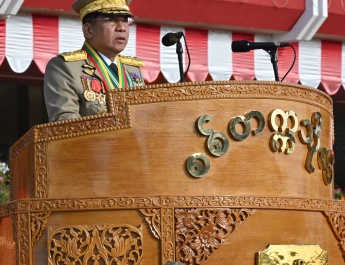
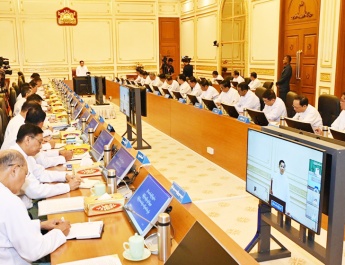
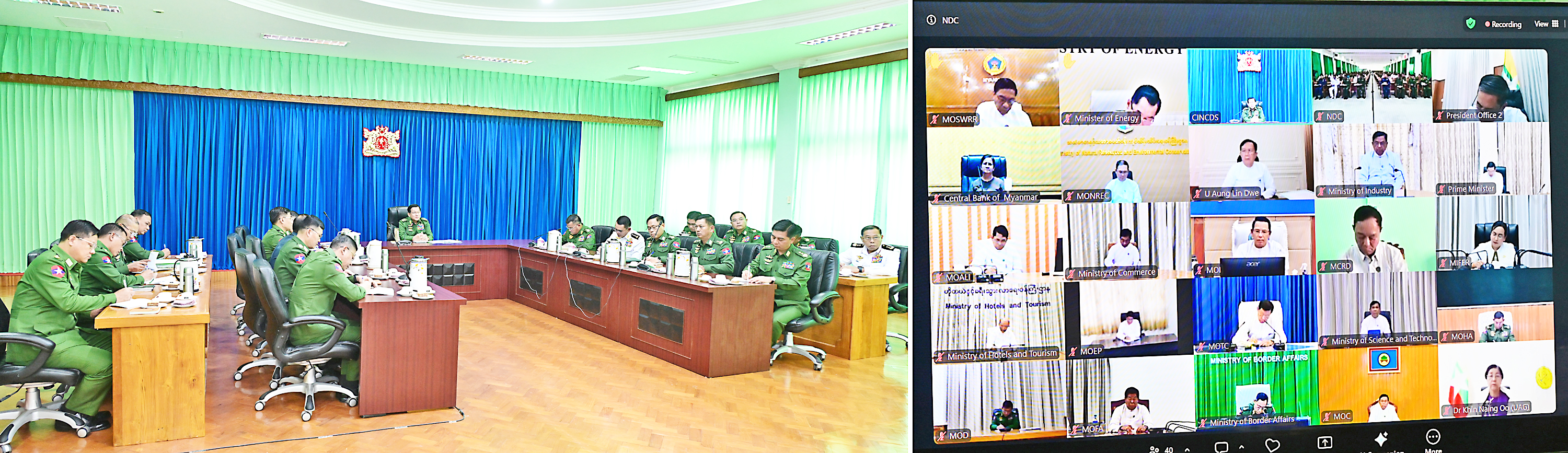
Acting President of the Re-public of the Union of Myanmar and Commander-in-Chief of Defence Services Senior General Min Aung Hlaing this afternoon gave guidance to senior officer instructors and senior officer trainees of the National Defence College through the video conferencing.
Also, present at the ceremony were Commission Vice Chairman Deputy Commander-in-Chief of Defence Services Commander-in-Chief (Army) Vice-Senior General Soe Win, Secretary of the Commission General Ye Win Oo, Commission member Chief of the General Staff (Army, Navy and Air) General Kyaw Swa Lin and senior military officers from the Office of the Commander-in-Chief (Army), Commission member Prime Minister U Nyo Saw, Executive Chief of the National Defence and Security Council U Aung Lin Dway, Union mini-sters, Union-level dignitaries, the Nay Pyi Taw Council Chairman, the commandant of NDC, senior officer instructors and senior officer trainees through the video conferencing.
Successful holding of the free and fair multi-party democratic general election
On the occasion, the Senior General said that the military and civilian trainees currently attending the National Defence College would be completing their courses in the near future, and that he wished to discuss and give guidance on the country’s evolving political situation and the necessary steps to be taken going forward for national development. Regarding the election, it had been conducted in three phases starting from 28 December, and that it was successfully held in 100 percent of the townships where elections were organized. As a multi-party democratic nation, he noted that the Tatmadaw itself was also firmly committed to walking the path of multiparty democracy. There were 13.14 million voters, representing more than 54 percent turnout, and that the enthusiastic participation of the public during the election demonstrated the people’s desire to proceed along the democratic path and their confidence in the actions of the government. Therefore, the government must respect the will of the people and carry out its responsibilities correctly and in line with the aspirations of the public.
Tatmadaw had assumed state responsibilities because irregularities occurred in the 2020 multi-party democratic general election. As a result of attempts to form a government with elected representatives produced by fraudulent elect-ion outcomes and to seize state power through unlawful means, the Tatmadaw had to take action to safeguard the State. These actions were not taken to seize state power, but were carried out in fulfillment of the duty to protect and safeguard the multi-party democratic system. He noted that throughout successive eras, the Tatmadaw had served the national interest and had endeavored to ensure the country’s progress step by step, in an evolutionary manner.
Since assuming state responsibilities in 2021, efforts had been made to correctly and sincerely follow the democratic path under an honest political system.
Since assuming State responsibilities, the forward work plans had clearly included the provision that state duties would be transferred back after the completion of election-related processes. The registration of political parties had been permitted in accordance with the law, and that parties not in compliance with rules and regulations were denied registration or deregistered. The formation of political parties involves acting as representatives of the people on the political stage, and that if parties engage in actions or statements harmful to the country, it becomes difficult to maintain order. Therefore, the Political Parties Registration Law was systematically enacted and implemented.
Permission for the registration of political parties was first granted in 2023, and that party activities aimed at increasing party membership were also authorized. Gathering party members essentially serves to organize the public, giving them a measure of collective representation. As party membership grows, the number of supporters increases, and the
processes of recruiting members and organizing voters were systematically permitted. However, some parties were unable to make effective use of the opportunities provided, and that in practice, they only operated offices in certain major cities. During the election, out of 24 million eligible voters, 13.13 million cast their votes, representing a 54.22 percent turnout. A total of 57 parties competed, with six parties participating across all regions and states. According to the election results, the Union Solidarity and Development Party received 44.19 percent, the Ethnic Unity and Harmony Party received 13.34 percent, the People’s Party received 8.85 percent, the People’s Pioneer Party received 7.65 percent, and the Shan and Ethnic Democratic Party received 6.17 percent. Parties with greater direct engagement with the public were able to gain stronger support from the people. He noted that they were able to conduct a free and fair election. Voting was carried out using the Myanmar Electronic Voting Machine (MEVM) system, which prevented electoral fraud, enabling a transparent and legitimate election process. Advance voting was also conducted accurately, with voter lists carefully verified and compiled. During advance voting, over 140,000 votes were rejected, and only those who met the strict eligibility criteria were allowed to vote in advance. The process was carried out systematically, ensuring that fraudulent voting could not occur. Some eligible voters did not cast their votes due to reasons such as: their preferred candidates were not on the ballot, local security concerns, lack of a wareness of their voting rights, intimidation or coercion, or being influenced by violent or forceful persuasion, which prevented them from coming to vote.
Strengthening patriotic spirit of all citizens and serving duty by public service personnel with clear knowledge over national cause and party politics
Regarding national affairs, based on the history of the country, all citizens need to have a sense of love for their state and nation. Historically, citizens have often been personality centered, giving loyalty to individuals rather than to the country itself. Instead of being attached to individuals, every citizen should have proper and genuine patriotism focused on the nation. Patriotism can be distinguished between citizen-related patriotism and official-related patriotism. As citizens, every-one should respect, value, and cherish the country’s existence, national identity, and symbols, including national emblems, the national flag, and the national anthem. According to reports on social media, in some movie theaters, people did not show proper respect for the national flag or refrain from singing the national anthem, which is disappointing. Observing such behavior, the level of genuine patriotism among citizens appears to be weakening. All citizens must show respect and reverence for the national flag and the national anthem and cultivate a true sense of love for their nation and country.
He stated that civil servants must also possess a sense of patriotism. Looking back at history, it is observed that some civil servants engaged in malpractice regarding eco-nomic and political matters. Such occurrences are due to a weakness in patriotic spirit. The majority of civil servants are individuals with at least a high school education or higher. If one examines the conflicts and crises that occurred in the State, it will be seen that civil servants were involved. It is already prescribed in the Constitution that civil servants must be free from party politics. It is observed that they tend to depend on individuals and organizations. It is seen that they act based on attachments to national leaders and political parties. If civil servants perform their duties with personal cults, party bias, or organizational attachment, Good Governance and Good Government cannot be achieved. Civil servants must be free from party politics, distinguish between politics and national affairs, and carry out the duties of the State. However, it was observed that certain disloyal civil servants abandoned their posts due to personal cults, party bias, and factionalism. Upon assuming duties in 2021, the administration had to rebuild the nation amidst a series of crisesranging from the mass desertion of posts by the majority of education and health sectors’ staff to political conflicts and natural disasters, including the COVID-19 pandemic. Consequently, it is imperative to cultivate and strengthen a sense of patriotism among both citizens and civil servants.
Educational reforms must be implemented as a necessity
He further noted that our country has lagged in political, economic, and educational sectors. For national progress, stability, and development, the educational standards of citizens must be elevated. As the motto “National discipline begins at school” suggests, only with formal education will there be an increase in disciplined citizens, significantly contributing to the nation’s progress, stability, and development. He also stated that the 2024 population and housing census details the state of the country, revealing a significant need to upgrade the education sector. Consequently, a compulsory KG+9 education system is being implemented to elevate the nation’s educational standards, alongside ongoing educational reforms. He pointed out that the majority of the country’s population is unable to pursue self-development, leading to widespread poverty. He noted that as long as poverty persists, personal grievances, envy, and dissatisfaction can arise. He added that historical instances of national instability in the country were found to be rooted in educational weaknesses.
Therefore, he emphasized that upgrading the education sector is an absolute necessity. He noted that daily saluting of the national flag starting from basic education schools will instill patriotism, whereas those who do not practice this will see their love for the country gradually diminish. Consequently, he urged all citizens to cooperate in ensuring that every school-aged child attend school.
He observed that agricultural and livestock production in our country is still being carried out using only traditional methods. He stressed the need to enhance formal education, vocational skills, and knowledge to improve the analytical thinking of all citizens. For those beyond school age who can no longer attend formal classes, he stated that knowledge must be elevated through out-of-school education by opening libraries. In doing so, he added that books, newspapers, and journals should use language easily understood by the public. He noted that only when readers understand the content will they gain beneficial knowledge, and urged everyone to work toward national progress.
Civil servants required to carry out duties systematically
The Central Institute of Civil Service (Phaunggyi), established during the era of the Burma Socialist Programme Party, was created to help civil servants understand the country’s conditions and responsibilities. Training courses are conducted according to the appropriate level, with the aim of enabling civil servants to carry out office work systematically and to foster patriotism. Training programs opened by individual ministries must also be conducted in a structured and orderly manner. Only through systematic training can disciplined and patriotic civil servants be developed. Office work systems across all departments should be standardized and implemented consistently. Official duties must be carried out systematically during office hours, as effective time management is essential for successful work.
In carrying out their responsibilities, every civil servant is required to be competent and effective in completing assigned tasks. Senior civil servants and military officers currently attending the National Defence College are expected, upon completion of their training, to take firm measures to ensure that the civil servants under their supervision work in an organized and disciplined manner.
Civil servants need to learn to manage their income and expenses in a balanced manner, as some have been punished for taking more money than necessary. The government has made every effort to ensure that civil servants can live comfortably. Under the current administration, benefits have been increased several times, nearly matching basic salaries. However, further improvements in the welfare of civil servants will depend on the continued development of the country’s economic sector.
Economic development centered on agriculture
As our country is primarily based on agriculture, income generated from agricultural activities is essential for increasing the national GDP and enabling greater support for civil servants. Only with higher national income can the salaries of civil servants be increased.
Since all sectors are interconected, collective effort and cooperation from everyone are necessary.
For the development of the national economy, activities must be carried out in a systematic and organized manner. Agricultural and livestock pro-duction needs to be improved through the use of modern technologies rather than traditional methods, alongside effective and structured management. Research and development are also essential, and agricultural and livestock activities should be aligned with international market demands. As Emata rice is our main crop, relevant ministries need to conduct research to ensure the production of high-quality rice. With the world’s population now exceeding eight billion, global food demand is expected to continue rising. To meet these growing needs, basic agricultural and livestock training schools are being opened in our country to develop educated and skilled human resources in these sectors. In addition, plans are underway to introduce basic agricultural and livestock skills at the secondary level of basic education. It is expected that ministries will work together in coordination to further improve agricultural and livestock activities nationwide.
Although the country produces sufficient raw materials for animal feed, livestock farming has not yet been carried out in a systematic manner. To strengthen food security in regions and states, livestock farming must be successfully and efficiently developed. This requires coordinated efforts and cooperation among all stakeholders. With further improvements in livestock production, livestock products can also be exported to foreign markets. If trainees approach their responsibilities from the four perspectives of politics, economics, administration, and defence, it will greatly benefit the country. At the same time, it is essential to produce adequate livestock-based food products domestically to meet national consumption needs.
For instance, in the industrial sector, cotton is grown in certain regions of the country and cotton-based textile industries are operating. However, cotton production data has been found to be statistically inaccurate. If cotton yields can be improved and accurately assessed, agricultural-based industrial pro-duction can be developed more effectively. Likewise, various other industrial crops are cultivated across the country, creating opportunities to expand agrobased industries. This will help increase national income, which in turn can contribute to higher salaries for civil servants and overall national development. Increased production is essential to boost both exports and domestic sales, generate foreign earnings, and stabilize the foreign exchange market. He urged trainees to gain a clear under-standing of the nature of their respective sectors and to work towards improving production.
If the trainees would work together with their individual thoughts and ideas for the development of the country, it would bring great benefits to the future of the country.