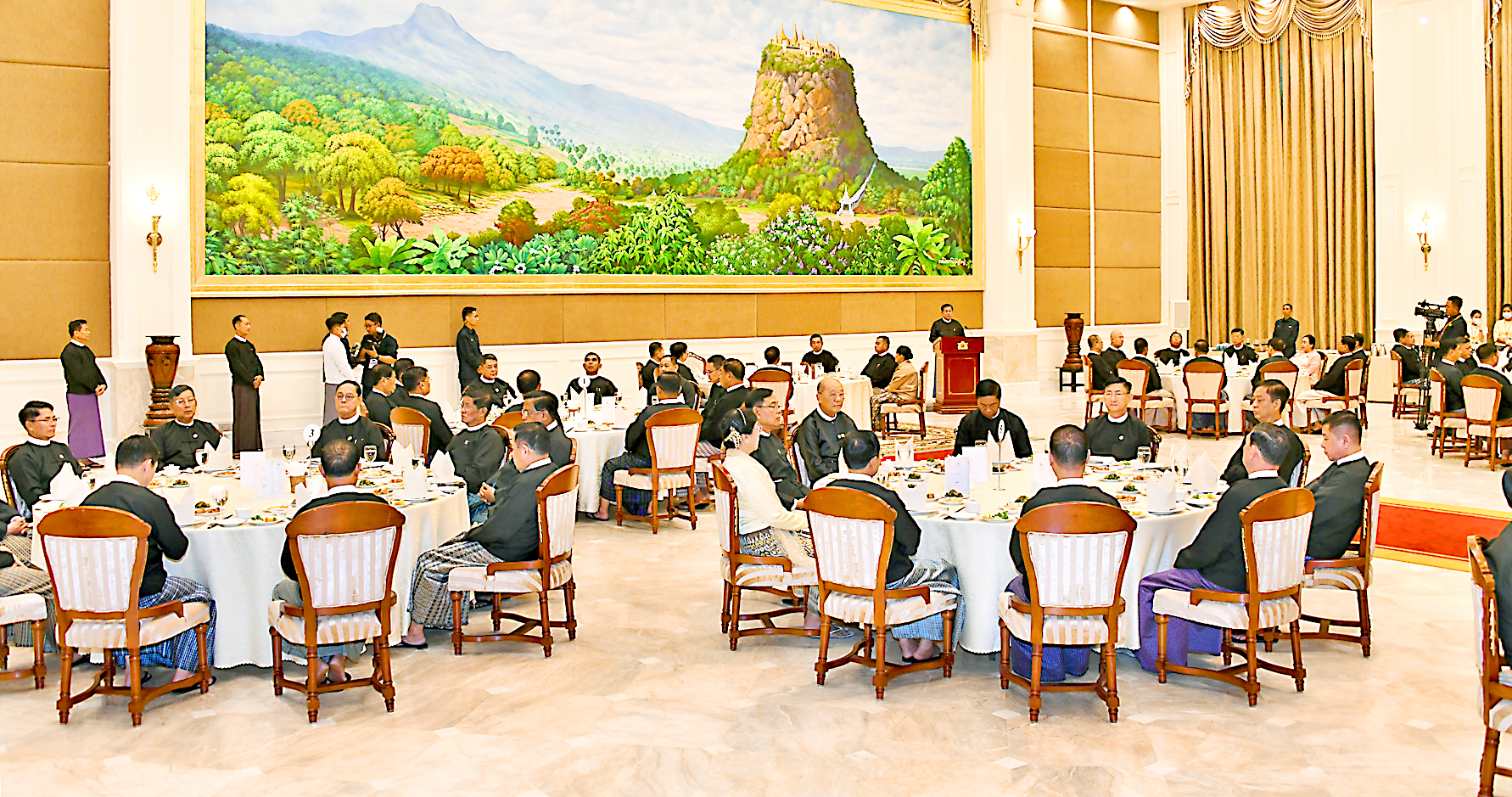
Nay Pyi Taw February 8
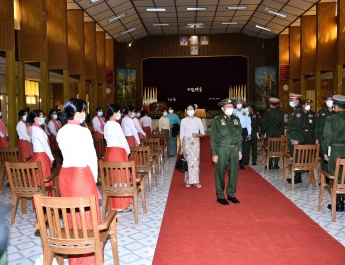
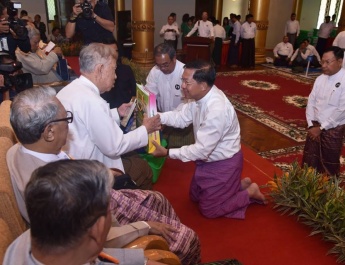
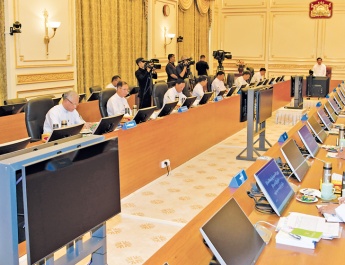
Senior General Min Aung Hlaing, Acting President of the Republic of the Union of Myanmar and Chairman of the State Security and Peace Commission, hosted a dinner this evening at the National Defence and Security Council Office Banquet Hall in honour of the Myanmar delegation that represented the country at the International Court of Justice (ICJ) hearing.
Also present at the dinner were Commission Vice Chairman Vice-Senior General Soe Win, Commission member Prime Minister U Nyo Saw, Executive Chief U Aung Lin Dway, Commission Secretary General Ye Win Oo, commission members, Union ministers, Union-level dignitaries, chief ministers of regions and states, senior military officers from the Office of the Commander-in-Chief, and officials from the Myanmar delegation which defended the case at the ICJ.
In his honorary speech, the Senior General said that he was especially delighted to have the opportunity to deliver remarks at the gala dinner being held. Just as the people across the entire country warmly welcomed, supported, and honoured the Myanmar delegation that went to appear and present oral arguments on behalf of Myanmar at the International Court of Justice during the final round of oral hearings in the case filed by The Gambia against Myanmar alleging genocide, led by Union Minister for the Ministry 2 of the President’s Office U Ko Ko Hlaing and Union Minister for Legal Affairs and Union Attorney General Dr Thida Oo, the State also, on behalf of the nation, was honouring and welcoming the delegation through the hosting of this honorary dinner.
The Senior General noted that the case filed by The Gambia against Myanmar at the International Court of Justice in 2019 had lasted for more than six years, and that the merits stage of the proceedings was completed in January 2026. He explained that after his government assumed state responsibilities in February 2021 in accordance with the Constitution, it had continued to handle the case in line with its responsibilities under public international law, whereby a succeeding government gene-rally inherits the actions and commitments undertaken by the previous government under the principle of state succession.
After the International Court of Justice began contacting them around mid-2021 regarding the continuation of the case, the government held thorough discussions among responsible officials on whether it should assume and continue handling the matter. Taking into account the prevailing international and domestic political circum-stances at the time, a decision was made to continue taking responsibility for the case, and two representatives were selected and appointed to serve as the Agent and Alternate Agent in charge of the proceedings.
When reviewing the international and domestic political situation at that time, it was a period in which Myanmar was facing numerous pressures and challenges both at home and abroad. The United Nations and its subordinate bodies were hesitant to officially recognize the government, and Myanmar had lost its right to speak on the international stage, including at the United Nations General Assembly, due to the defection of its Permanent Representative. Similarly, it was also a time when Myanmar’s government leaders were politically sidelined within ASEAN.
Domestically, it was also a time when the COVID-19 pandemic was spreading severely and widespread, intense unrest of an anarchic nature was occurring. In such circumstances, the government carefully assessed the potential outcomes, weighing both the benefits and risks, before deciding to assume and continue handling the case. The main reason for this decision was that, at the International Court of Justice, the proceedings could continue unilaterally even if Myanmar chose not to participate. In such a unilateral process, the Court would consider only one-sided information, which could lead to undesirable consequences. This, in turn, could leave Myanmar with an indelible stain on its national dignity throughout history and could give rise to further unwanted re-
percussions. Therefore, given the conditions at that time, that course of action was chosen as the best possible solution.
As Myanmar would have to face the proceedings step by step, a leading committee on litigation before the International Court of Justice was formed to ensure the best possible preparation, comprising multiple relevant ministries, including Foreign Affairs, Defence, Home Affairs, Legal Affairs, Immigration, and Social Welfare, Relief and Resettlement, and that coordinated efforts were undertaken accordingly.
For legal support, a team of senior domestic legal scholars and an advisory legal committee was formed to provide legal advice, while an international team of lawyers was also engaged to participate in the case. In addition, to ensure that historical information and evidence were obtained accurately and comprehensively, a foreign expert on Rakhine history was also hired to assist in the proceedings.
Because efforts were carried out systematically and in a coordinated, unified manner, sufficient time was available according to the originally planned strategy, and all preparations for the case were carried out thoroughly and firmly.
The Senior General stated that, during the final stage of the case—the oral hearings held at the International Court of Justice from 12 to 29 January—Myanmar’s delegation was able to defend and present its case strongly and effectively due to thorough prior preparation. For this reason, he expressed that the State commends and honours the Myanmar delegation, led by the two Agents.
In truth, the case Myanmar faced at the International Court of Justice was not an accusation against any individual or group of people, but rather a case brought against the Republic of the Union of Myanmar. There-fore, as the entire nation including the country, its people, and the government was being accused in the proceedings, the case directly concerned the dignity of the State and of all its citizens, making it an issue of special significance for the country.
He stated that he wished to express the State’s special gratitude to the Myanmar delegation and all relevant departments that provided support, as it was learned that the delegation was able to stand firm and present comprehensive legal and factual arguments in this case.
He noted that although this case represents a very significant challenge for Myanmar, it was observed that the country was able to turn this challenge into a benefit. He stated that among these benefits, the most important point is the evidence of national unity; as the saying goes, “Unity in times of crisis,” the entire people of Myanmar stood united with the government, fully supporting and defending the country with patriotism against the unfair accusations in this case.
He stated that as another benefit, the country was able to present Myanmar’s position on the international stage with solid evidence regarding a politically fabricated identity, which has been a root cause of the long-standing issues in northern Rakhine State.
Additionally, he noted that in terms of legal matters, international-level experience was gained from this case. He stated that it could be considered a silver lining, as the country acquired the knowledge and insight on how to best prepare should similar legal attacks against the nation occur in the future.
He stated that regardless of the intentions of the ICJ, a United Nations organ, the Myanmar delegation approached this case without distinguishing between major or minor issues, preparing systematically and acting with full strength and unwavering perseverance—akin to a lion hunting its prey. He noted that it was due to these efforts that such a status could be achieved. Therefore, he expressed special gratitude and honor to the two leaders and all members of the Myanmar delegation.
He urged that regardless of the challenges faced in the current landscape of international power politics, where small nations must stand on their own self-reliance, the State and its citizens must work together. He stated that it must be taken as a national duty to
protect the vital interests of the country—the non-disintegration of the Union, the non-disintegration of national solidarity, and Perpetuation of sovereignty—by remaining as united as they were in this current event.
Afterward, Union Minister for the Ministry of the State Administration Council Office (2) U Ko Ko Hlaing, as the leader of the Myanmar delegation that traveled to the International Court of Justice (ICJ), provided a brief on the proceedings. He noted that the Myanmar delegation had conducted systematic preparations, including collecting necessary data and ensuring that facts and historical records were comprehensive. He stated that a legal advisory team consisting of veteran local legal experts was formed to obtain legal counsel, and an international legal team along with a historical expert was hired to represent the case. He added that these efforts were carried out with unity and systematic diligence, complemented by the guidance and support of the Head of State. Furthermore, he expressed deep gratitude for the warm welcome and the honorary dinner hosted for the delegation members.
Afterward, it is reported that the Senior General and the attendees had the honorary dinner together.