Nay Pyi Taw February 6
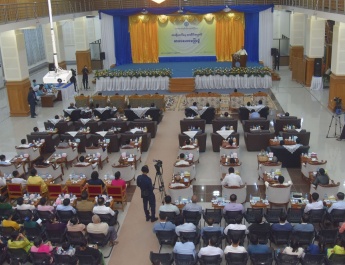
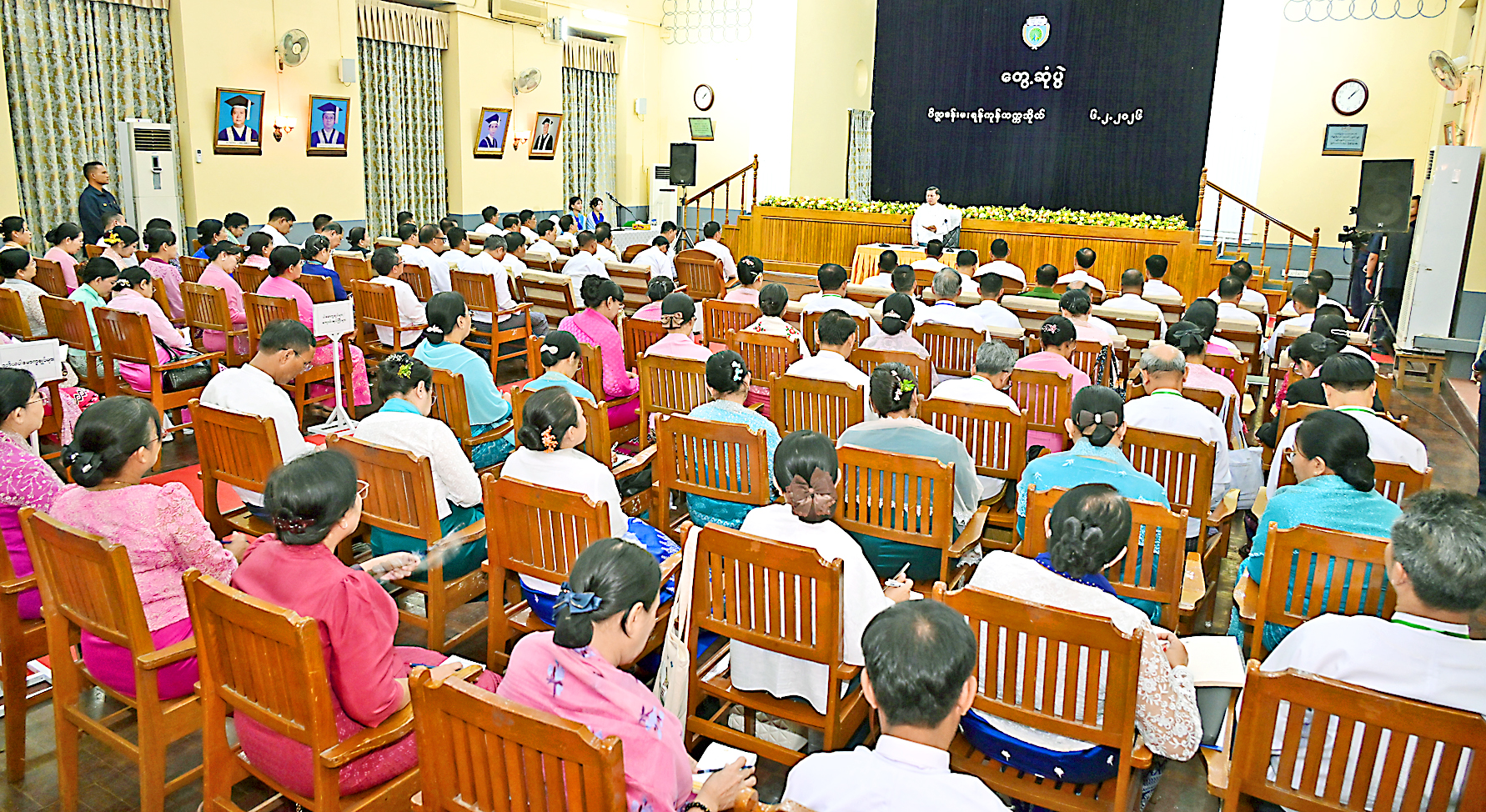
Acting President of the Republic of the Union of Myanmar Chairman of State Security and Peace Commission Senior General Min Aung Hlaing met rec-tors, principals, professors, and faculty members of universities and degree colleges of the relevant ministries at the Arts Hall of Yangon University this afternoon.
Also present at the meeting were SSPC member Prime Minister U Nyo Saw, SSPC Secretary General Ye Win Oo and members of the entourage, the Yangon Region Chief Minister, the Yangon Command commander, directors general of the Ministry of Education, deputy directors general, rectors of universities for technology and medical science.
Promotion of education sector of State
In his address, the Senior General said the meeting is for the promotion of the education sector of the State. The findings of the 2024 census indicate the national literacy rate at over 91.1 percent, but the number of high school and university level educated persons is low, and the number of students who completed primary education level is high. The comparison between the said census result and the records of the 2014 population housing census and 2019 interim census shows a great demand for the national education promotion activities.
Promotion of basic education sector
The country was weak in educational activities because of the colonial education system during the pre-independence period and the world war. Hence, three R campaigns were launched in the post-independence period to eradicate illiteracy, but school education was weak since the time, and the result was the fewer number of educated persons in the country. History shows that weakness in education harmed national peace and stability at times.
As the saying goes “National discipline starts at schools”, those who have formal education have the habit of observing discipline better than the ones who lack formal education. As the former are the persons who are brought under the teachings of their teachers, they are polite and obey the discipline. Weakness in education has a huge impact on national peace and stability and rule enforcement. It can be assumed that political conflicts erupted throughout the successive eras were the result of the weakness in education. Because of their educational deficiency, these people can be easily influenced by others’ instigations and their thoughtless acts have ruined the national peace and stability.
Citizens’ mindset should be enhanced through education promotion, which will have two phases – (1) enrollment of all school age children and (2) application of a teaching method that truly educates students. In the basic education sector, some schools meet the norms, but some lack standard features, and the same goes to institutions of higher learning. Schools must meet the set standards so that students can learn their lessons well and have the will to learn. Teachers on their part must enhance their teaching skills.
Modern teaching methods that meet the present age must be adopted. School age children’s enthusiasm for learning must be improved and the development in teaching needs constant research programs. Students must be taught well from the primary level education till finishing their high school and to observe the rules, and the work calls for enhancing the qualifications of teachers.
The task of upgrading all basic education schools needs time. School attendance rate is low in some ethnic areas as there are children who cannot attend classes due to language barrier and other difficulties. Serious attention must be paid to education promotion activities in ethnic areas with demands for education. Education pro-motion in ethnic areas calls for teachers that are really supportive of the students. Efforts must be made to arouse children’s will to attend classes and to create a pleasant ambience for them. All preprimary students reach the primary school level, but not all primary school students come from preprimary schools. Teaching methods must ensure a pleasant environment for children. Teachers of KG and KG+1 must pay close attention to ensuring a happy environment for children. Hence, the Education Ministry is conducting short-term courses beginning from this year for the nation’s future.
The country has government schools, monastic education schools and private schools, but most of the children of the people go to government schools. As parents of these children cannot afford to send their children to private schools, they are relying on government schools. Hence, the quality of government schools should be improved. The government in office is improving the features of the schools and facilitating the teaching activities to the most possible degree. It is a must to improve the education from its roots for the betterment of the country’s future.
Whatever the teacher appointment system is, efforts must be made to ensure equal qualifi-
cation among teachers. Education staff are provided with benefits rank wise. And support
for ensuring a comfortable living for teachers has been fulfilled to the most possible extent. Allowances for all civil servants including education staff have been increased.
A pleasant occupational ambience for teachers enhances their will to serve their duty.
The State is fulfilling the needs for disseminating general and academic knowledge for children. The country must nurture education trees for the country’s future. Children with better educational foundations will reach institutions of higher learning.
Advancement of the Higher Education Sector
Regarding higher education, he noted that universities and institutes offer diploma, under-graduate, and postgraduate levels. He mentioned that there are many students who do not pass the matriculation exam after completing their final year of high school. He stated that arrangements must be made for these students to continue their studies through vocational education and diploma programs. For those who pass the matriculation exam, it is necessary to continue training them to become high-quality individuals. Regarding distance education universities, he stressed the need to ensure systematic teaching and to enhance proficiency levels. He urged for university education to be improv-ed further and for efforts to be made to provide mastery of higher education through diligent teaching.
He explained that universities provide advanced knowledge and expertise. He added that students gain exposure to di-verse academic fields and social environments during their time at university. Engaging within the university community pro-vides individual students with valuable experiences and fosters positive thinking. Therefore, he noted that only when these social environments are healthy and positive can the universities produce individuals capable of serving the interests of the nation.
He noted that students have different social experiences depending on the environment in which they are educated. These experiences result in differences between individual social circles. Only by acquiring good habits within their social communities will there be an abundance of educated human resources capable of serving the nation’s interests. Currently, the government is doing its best to improve the characteristics of universities and colleges. Essential infrastructure is being provided, starting with cleaning and beautification tasks to ensure students have access to sports facilities and good environments. He stressed that those in charge must work diligently to create favourable environments in universities.
By doing so, our social communities will be transformed and improved.
He explained that university education is a system that emphasizes study and discussion over mere teaching. He stressed that university education must be taught in a way that ensures genuine proficiency and understanding. Therefore, in higher education universities, it is necessary to carry out studies and interactive discussions with teachers. To ensure students truly become educated, he stated that a system of Check, Recheck, and Counter Check must be implemented through various methods. He concluded by urging officials to create favou rable environments for the students’ attending universities.
From Elevating Educational Standards to National Development
He stated that industrial, agricultural, and livestock basic education schools have been opened to provide the human resources necessary for the country’s primary economic activities of agriculture and livestock. He noted that doing so will provide the support needed to advance the nation’s agricultural and livestock production sectors. By increasing production, the national GDP will rise, leading to the improvement and growth of the country’s economy. Therefore, he emphasized that efforts must be made to ensure the progress of agricultural and livestock production. He stated that he consistently encourages the implementation of agricultural and livestock production activities in each region and state to support local food security. He noted that the country also requires economists; therefore, as it is necessary to teach basic economic principles at universities, his government has planned for universities and colleges to offer BA (Economics) degrees and teach economic fundamentals. Similarly, he mentioned that since it is essential to understand the law in a democratic nation, basic legal subjects are being taught, and measures are being taken to confer BA (Law) degrees.
He mentioned that large amounts of foreign currency are being spent annually because the country has to import cooking oil and fuel from abroad. He also noted that significant State funds were utilized during the recovery efforts for the damage caused by the major Mandalay earthquake. Therefore, he stressed the need to boost product-ion activities to improve the national economy, emphasizing that we must take necessary actions to achieve selfreliance. He stated that the government is making efforts to increase the national GDP. By achieving production goals and targets, export earnings will increase, leading to a rise in the country’s GDP. He emphasized that the nation must utilize its human resources with a genuine will to drive national economic growth. He urged the attending senior teachers and professors, who hold high-level responsibilities, to collaborate in striving for the betterment of the country. He stated that to ensure a bright future for Myanmar, the education sector must undergo mandatory transformation and implementation. He requested them to perform their duties excellently within their respective sectors. He added that the government is encouraging and working toward the elevation of the education and health sectors. He concluded by asking them to produce students who are human resources rich in both knowledge and technical expertise.
Afterward, the Senior General cordially greeted those in attendance at the meeting.
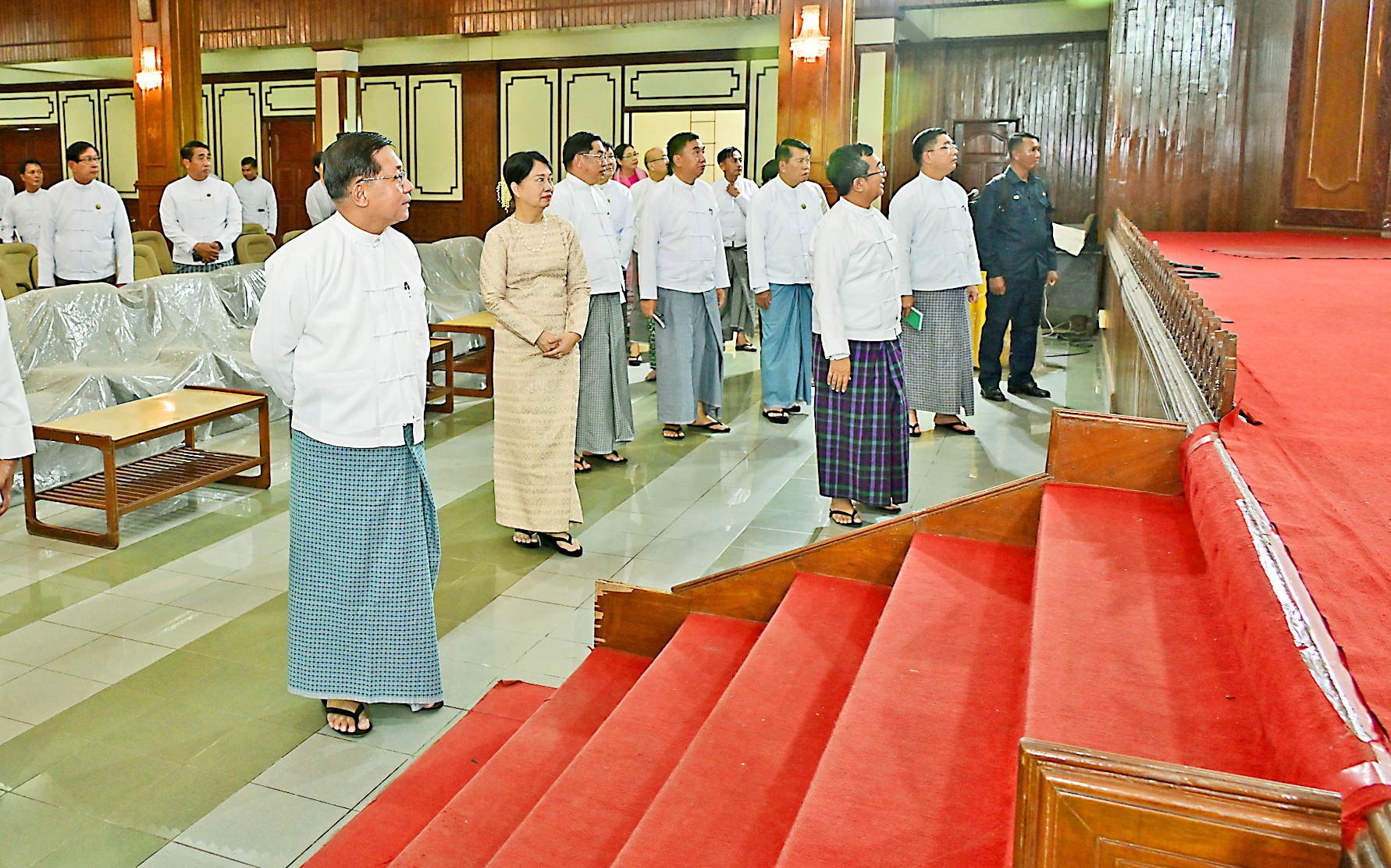
Then, the Senior General inspected the Diamond Jubilee Hall of Yangon University and gave guidance to responsible officials regarding the upgrading and renovation of the hall.