Nay Pyi Taw February 6
The opening ceremony of the Myanmar–Korea Friendship (Dala) Bridge in Yangon Region was held this morning and attended by Senior General Min Aung Hlaing, Acting President of the Republic of the Union of Myanmar and Chairman of the State Security and Peace Commission.
Also present at the ceremony were SSPC members Prime Minister U Nyo Saw, SSPC Secretary General Ye Win Oo, Union Ministers, the Yangon Region Chief Minister, senior military officers from the Office of the Commander-in-Chief, the Yangon Command commander, officials from the Ministry of Construction, representatives of companies involved in the bridge project, and engineers from Korea, China, and Myanmar.
Upon arrival at the venue, the Senior General and party were welcomed by responsible officials. The ceremony began with an explanation by Union Minister for Construction U Myo Thant regarding the construction of the Myanmar–Korea Friendship (Dala) Bridge.
A documentary movie on the bridge project was then presented. Afterwards, a representative from Soosung Company of Korea, the project contractor, handed over relevant construct-ion documents to U Kyaw Kaung Cho, Director General of the Bridge Department under the Ministry of Construction.
The Union Minister for Construction also presented a commemorative gift to the Senior General to mark the opening of the bridge.
In his opening address, the Senior General said the day marked an auspicious milestone, as the bridge successfully connects Yangon, the country’s commercial capital, with Dala Township across the river. He noted that the bridge integrates Dala into Yangon’s urban area and stands as a historic development.
The newly completed bridge is 6,127 feet long and designed as a four-lane structure. Unlike other bridges, it was built to serve as a landmark of Yangon. It is also the tallest cable-stayed bridge in Myanmar, allowing large sea-going vessels to pass underneath, and was constructed to be both strong and aesthetically impressive. He said he was as delighted as the local people.
He said discussions between Myanmar and Korea regarding the project began in 2012. Construction started in 2019 with funding from a US$-157.833 mill-ion loan from Korea’s Economic Development Cooperation Fund (EDCF) and a government contribution of US$-30.341 million, totaling US$-188.174 million. An additional Ks-23.062 billion from the state budget was later allocated to complete the project.
The government, he said, is prioritizing infrastructure development across regions and states, including transportation by air, water, and land, as well as electricity access, to improve socio-economic conditions. He emphasized that good transportation links are essential for regional development and for strengthening connections among ethnic communities.
Easy and fast transportation is a crucial factor among the primary requirements for the development of a region. To prioritize improvements in transportation, bridges are being constructed at geographic and natural barriers such as rivers and streams. Roads are being built and upgraded to be passable in all seasons. These efforts are being implemented not only in urban areas but also to ensure the balanced development of even remote regions.
When implementing such development projects for the nation, it is necessary for the responsible authorities to collaborate to ensure that public funds are used without wastage, that quality is ensured for long-term durability, and to point out and correct whether or not the projects are beneficial for the region. It is also necessary that projects utilizing public funds are those that will yield benefits for the region.
Yangon Region is a major city for Myanmar’s economic development. Along with the regional economic growth and the increase in population, daily vehicle traffic has also significantly increased. Therefore, to ensure orderly traffic flow in Yangon Region in line with the characteristics of a capital city, infrastructure developments such as the expansion of inner-city roads, the construction of flyovers, and the construction of necessary four-lane major river-crossing bridges like the current one help reduce traffic congestion. As the flow of passengers and goods becomes faster, the economic, social, and health sectors of the public will further develop.
With the completion of the Myanmar-Korea Friendship (Dala) Bridge, it will be possible to travel easily and quickly from Yangon City, Yangon Region to Dala, Twantay, Kawhmu, and Kungyangon towns. Further-more, from there, it will also be possible to travel easily and quickly to towns in Ayeyawady Region. Dala town has become a gateway town connecting Ayeyawady Region and Yangon Region, allowing regional pro-ducts to be transported by road in a short time. Additionally, via the Daydaye Bridge, it will be possible to easily and quickly connect and travel to towns in Ayeyawady Region, including Daydaye, Pyapon, Bogale towns, and beach areas. As it is now possible to directly connect and operate road transportation with the central area of Yangon City, Dala town, including Twantay, Kawhmu, and Kungyangon towns, will also become urbanized and develop simultaneously.
The Government has set visions and objectives for the emergence of national interests and is striving with constant vigilance, unwavering perseverance, diligence, and effort. To en-sure a peaceful and prosperous future for the country and for the joyful and happy lives of the citizens, the Government is endeavouring to shape good visions and directions. It is urged that all citizens and national brethren also increase their cooperation in the Government’s processes for peace and the development of democracy and federalism.
To ensure public safety while using the Myanmar–Korea Friendship (Dala) Bridge, the public is urged to strictly comply with designated traffic and road regulations and to cooperate in safeguarding and maintaining the bridge to ensure its long-term durability and stability. The State Government extends its sincere appreciation to the Government of the Republic of Korea, officials responsible for the bridge construction, personnel from the Ministry of Construction, the Yangon Region Government, relevant military and government officials, and local residents for their collective efforts in achieving the successful opening of the bridge, said the Senior General.
The Senior General, then presented commemorative gifts to the construction engineering teams involved in the bridge project.
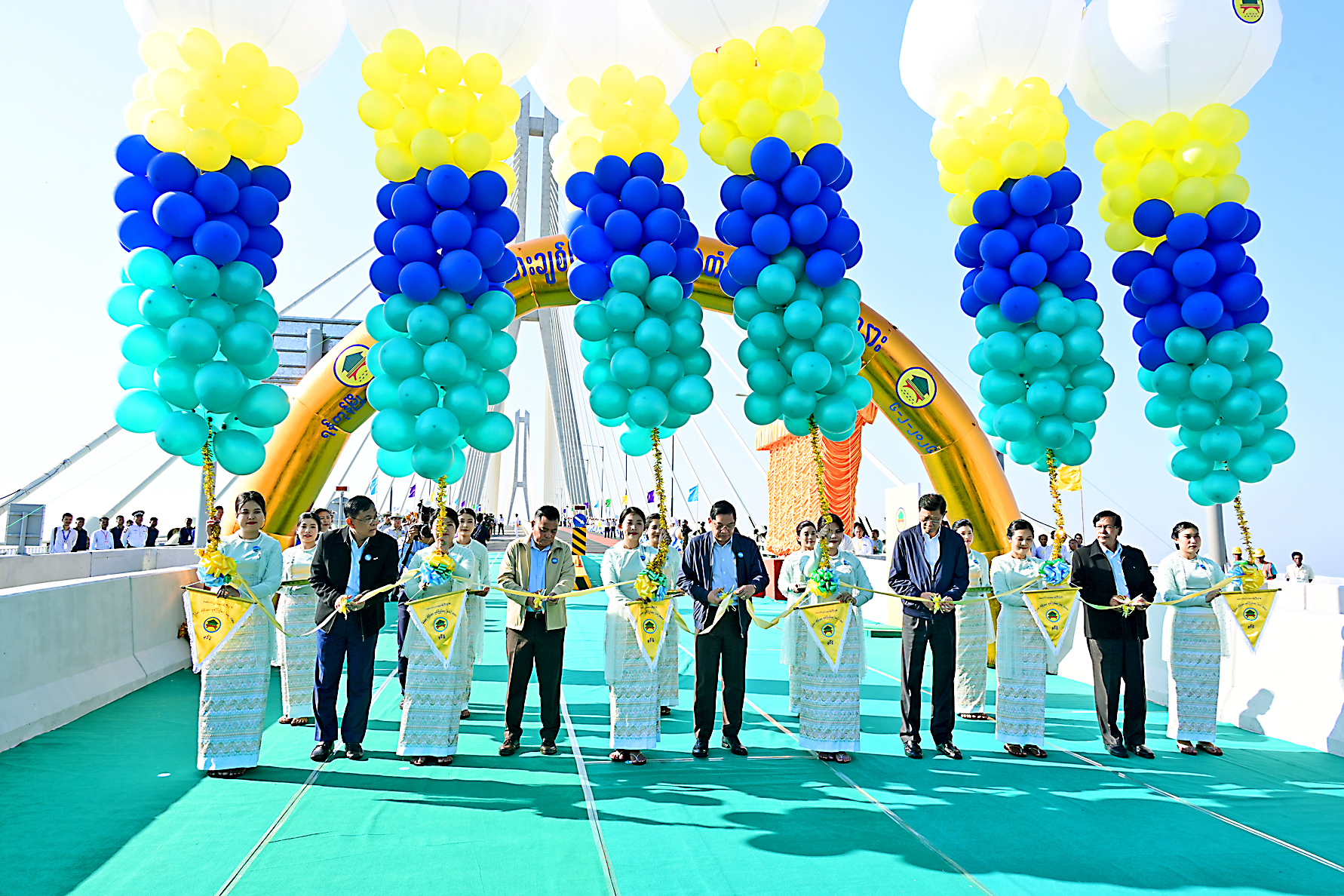
Following this, the Senior General arrived at the venue of the Myanmar–Korea Friend-ship Bridge ribbon-cutting ceremony, where Commission members, Prime Minister U Nyo Saw, Commission Secretary General Ye Win Oo, Union Minister for Transport and Communications U Mya Htun Oo, Union Minister for Construction U Myo Thant, and Yangon Region Chief Minister U Soe Thein jointly cut the ribbon.
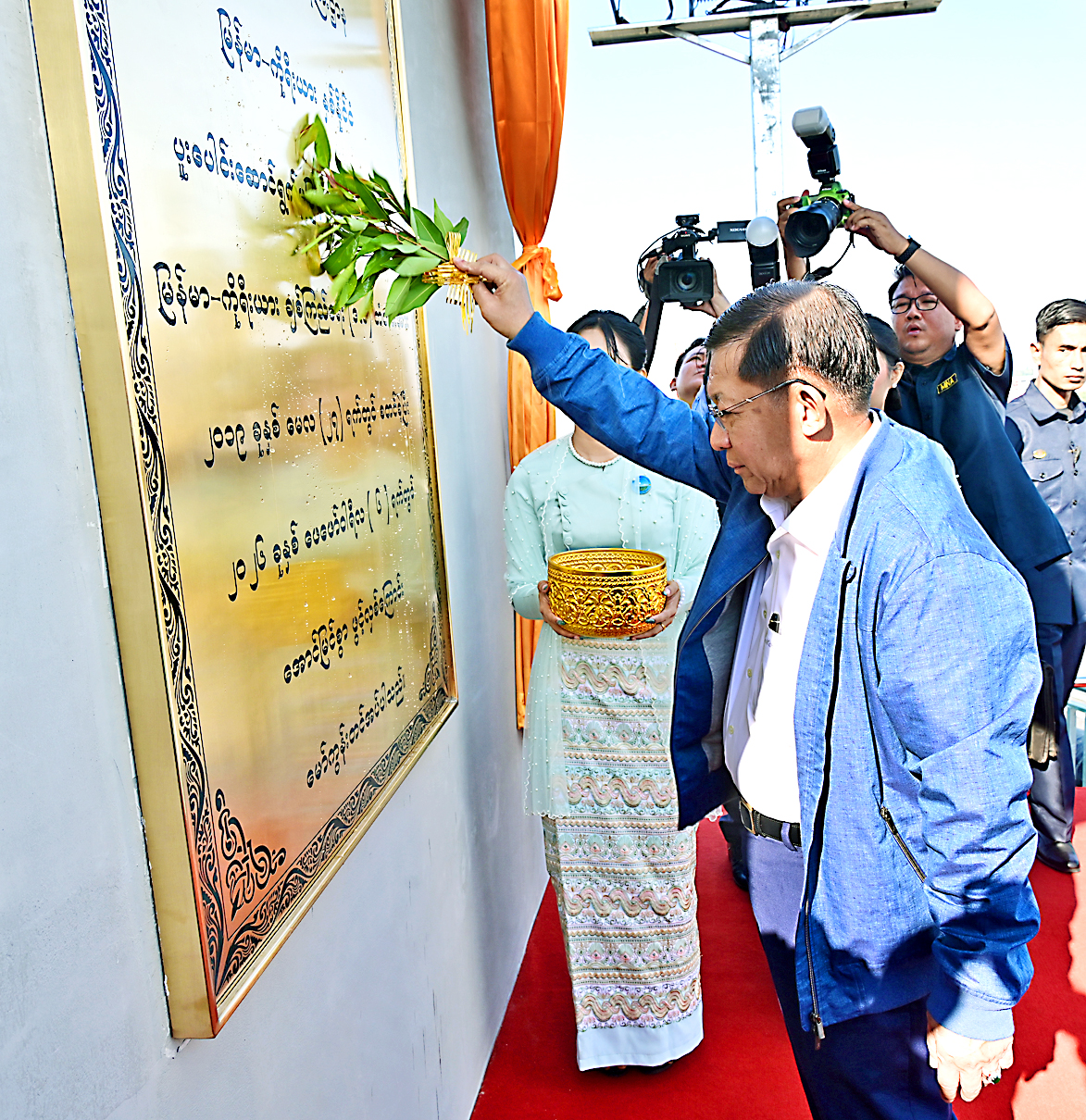
Following this, the Senior General officially unveiled the monumental inscription of the Myanmar–Korea Friendship (Dala) Bridge by pressing a button and sprinkling fragrant water. The Prime Minister, the Commission Secretary, Com-mission members, and officials subsequently sprinkled fragrant water on the inscription.
Following this, the Senior General together with commission members proceeded to Pylon-2, where the monumental inscription is located, and sprinkled fragrant water on the inscription.


Then, the Senior General and other attendees then posed for a group photograph to commemorate the opening of the Myanmar–Korea Friendship (Dala) Bridge.
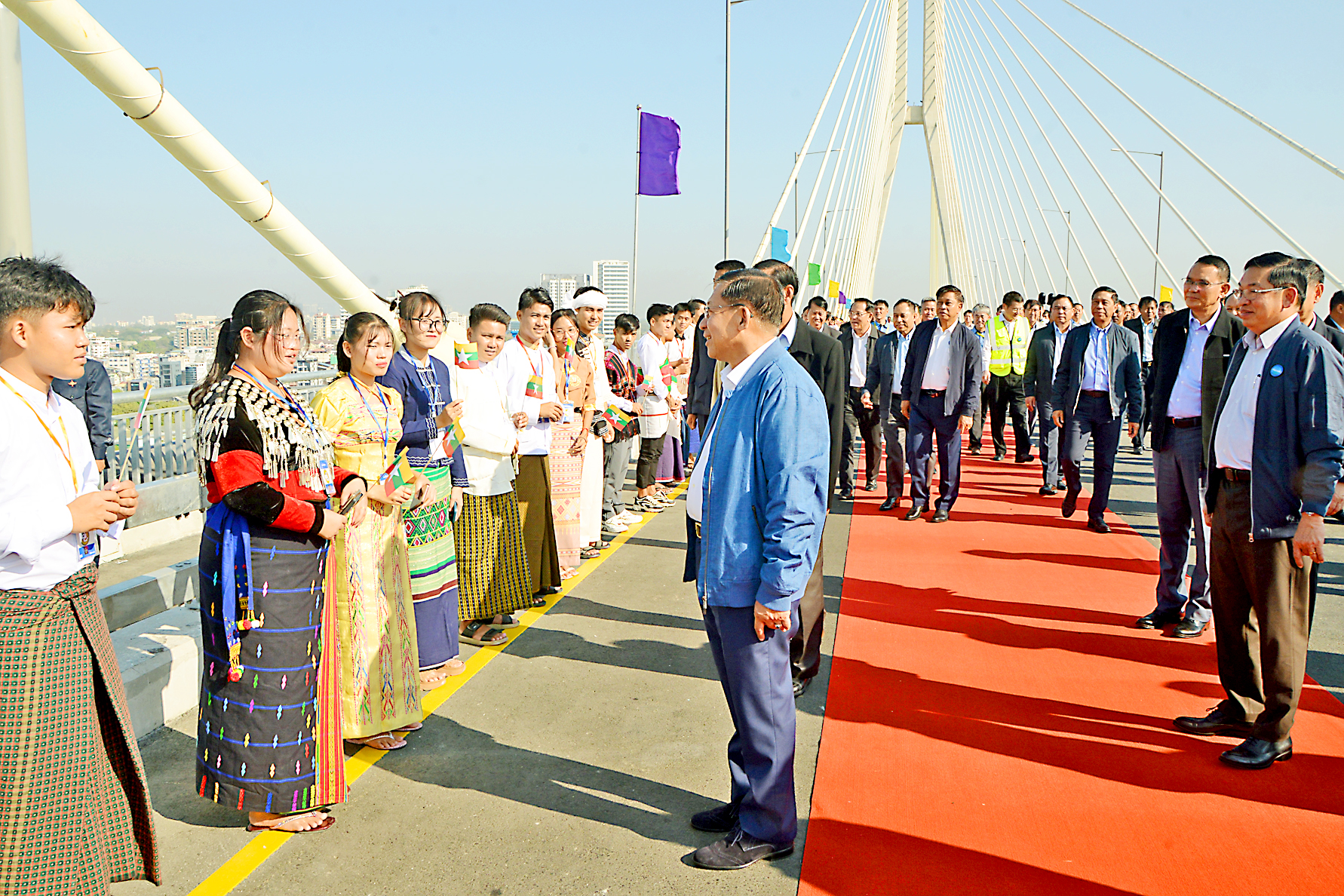
Next, the Senior General and members walked across the Myanmar–Korea Friendship (Dala) Bridge and greeted the ethnic youths attending the ceremony.
The Union Minister for Construction then presented the proposed beautification plan for the areas along the banks of the Myanmar–Korea Friendship (Dala) Bridge, after which the Senior General provided necessary guidance and instructions.
Then, the Senior General and members toured Dala town by vehicle.
The Myanmar–Korea Friend-ship (Dala) Bridge was first discussed by the two leaders during President U Thein Sein’s visit to the Republic of Korea in October 2012. On June 19, 2013, officials from both countries met and agreed to construct a bridge over the Yangon River using a loan from the Republic of Korea’s Economic Development Cooperation Fund (EDCF). The feasibility study for the project began in April 2013 with support from the Republic of Korea. The bridge was designed to meet Myanmar’s road and traffic conditions, geological and soil-bearing capacities, and social and economic requirements.
Construction of the bridge commenced on May 27, 2019. The main bridge has a gradient of 5.95 percent and a total length of 6,127 feet. It has an overall width of 79 feet, including four carriageways each 11 feet 6 inches wide and two pedestrian lanes each 6 feet 6 inches wide. The bridge is designed to support vehicles weighing up to 75 tons. Additionally, 1-foot-6-inch-diameter water pipes have been installed on each side to supply drinking water from Yangon to Dala.
The bridge was completed after the government was able to allocate additional state funds to overcome the challenges posed by the COVID-19 pandemic and other difficulties encountered during construction. With the completion of the Myanmar–Korea Friendship (Dala) Bridge, travel between Yangon and Dala, Twantay, Kawhmu, Kungyangon, and other towns in the Ayeyawady Region will become faster and more convenient. Dala is expected to emerge as a gateway connecting the Ayeyawady and Yangon regions, fostering development across various sectors. The neighbouring towns of Twantay, Kawhmu, and Kungyangon are also anticipated to grow into urban centers. The construct-ion and opening of this bridge will contribute to the social, economic, educational, health, and transportation development of the region, establishing it as a landmark infrastructure in Yangon.