Nay Pyi Taw March 6
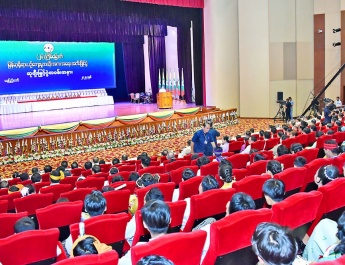
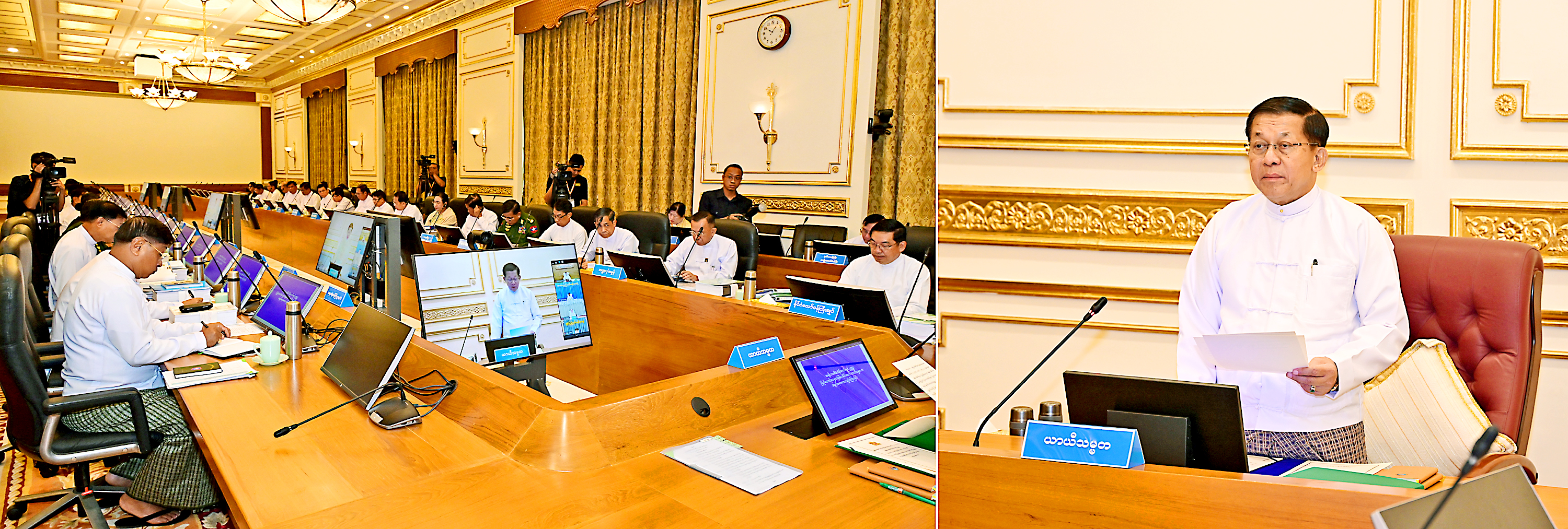
The Financial Commission held meeting (1/2026) at the meeting hall of Office of the Chairman of National Defence and Security Council in Nay Pyi Taw this afternoon, addressed by Chairman of the Commission, Acting President of the Republic of the Union of Myanmar, Chairman of the State Security and Peace Commission, Senior General Min Aung Hlaing.
Also present were Vice Chairman of the Commission, SSPC member Prime Minister U Nyo Saw, Secretary of the Commission Union Minister for Finance and Revenue Dr Kan Zaw, invited union ministers, Union Attorney-General and Union Minister for Legal Affairs Dr Thida Oo, Union Auditor-General Dr Khin Naing Oo, the Nay Pyi Taw Council chair, and deputy ministers. Region/state chief ministers attended the meeting through video conferencing.
In his keynote address, the Senior General said the meeting will have to discuss and approve the Union budget and Union budget bill for financial year 2026-2027.
The NDSC had already held the multi-party democracy general election in accord with its four objectives beginning 28 December 2025. The State duties will be transferred to the government elected and appointed by the relevant parliamentary sessions. The government in office has already laid the foundation of good practices and success. Hence, the next administration will have to earmark priority expenses sector wise.
As usual, the State is annually allowing necessary expenses for the priority sector, the agriculture and livestock sector, development of MSMEs for national economic promotion and import substitution, education and health sectors for human resources development, for mandatory expenses of other sectors, for maintaining, substituting the State infrastructure destroyed by natural and other disasters, and rehabilitation undertakings. In this year, requirements must be scrutinized and allocated.
The union level institutions, organizations and region/state governments must use the allocated funds in the interest of the State. Hence, supervision is required for timely completion of the planned tasks, striking a balance between work completion and expense, meeting the set quality and preventing financial waste.
Portions of the mandatory functions of the budget for 2026-2027 FY that can be completed within the FY for State’s policy, goals and work programs must be scrutinized and earmarked, and it is an important task.
The GDP for 2026-2027 FY is set to reach Ks-195,032 billion and economic development rate at 3.4 percent. The Senior General invited discussions and approval.
In his discussion, the Prime Minister said budgets for 2026-2027 FY have already been submitted by the union level insti-tutions and regions and states and they have already been passed through the relevant departments, organizations and committees. Revenue projects, expenses and current expenditures, capital expenditures and debt repayments have already been approved.Expenditures for the matters that occurred due to unforeseen events and natural disasters, allowances for civil servants and technological development undertakings have already been earmarked. The Union budget for 2026-2027 FY and the Union budget bill that is based on the Union budget is submitted for review, approval and recommendation of the Financial Commission.
Then, Secretary of the Financial Commission Union Minister Dr Kan Zaw reported to the meeting on the Union Budget Bill for 2026-2027 Fiscal Year and the Union Taxation Bill for 2026 Fiscal Year.
Afterward, Union Attorney General Union Minister for Legal Affairs Dr Thida Oo and Union Auditor General Dr Khin Naing Oo made suggestions on the union budget bill and measures that should be taken in the future based on findings over budgets of union-level organizations, ministries and state and regional governments respectively.
Then, the chairman of Nay Pyi Taw Council, chief ministers of regions and states submitted reports.
Concerning the reports, the Senior General made additional remarks, saying the government needs to make continued efforts for GDP growth while it is necessary to take measures for development of agriculture and livestock industries, which are major sectors of the economy of the country. By doing so, other manufacturing sectors and services sectors will make progress. Essentially, it is necessary to work really hard. Union-level organizations, state and regional governments are urged to place emphasis on economic development of the country and to take detailed systematic measures to enable the upcoming government to spend allocated budgets actually.
In his concluding remarks, the Senior General said discussions about the Union Budget Bill for 2026-2027 Fiscal Year and the union budget and the Union Taxation Bill for 2026 Fiscal Year have been made today and measures must be taken in accordance with the rules and regulations.
The government has been exerting efforts for prosperity of the country, security of food, water and basic needs and development of MSMEs. In doing so, priority must be given to development of agro-based industries, the main driving force of the economic development of the country, and to achieve sustainable development goals for the future.
To boost the economy of the country, actual GDP growth is an important outcome. Moreover, it is necessary to take steps for development of manufacturing industries, export promotion, import substitutes, domestic and foreign trade and services and creating job opportunities.
He stated that a robust and high-quality education system is a vital component for achieving a strong economy, noting that a nation’s progress is directly dependent on the educational standards of its citizens. He added that education enhances the analytical skills of the ethnic populace and fosters national unity, emphasizing that the country must prioritize the development of knowledge-based human resources and elevate the education sector to ensure a prosperous future for the nation.
Also, he stated that ethnic unity is crucial for national stability and the rule of law, urging all ethnic citizens to maintain wisdom and mindfulness while standing firmly on the NCA path to collectively strive for perpetual peace. He added that only through peace can the nation and the socio-economic lives of its people flourish, emphasizing the need to continue efforts toward achieving peace for the development of both the public and the State.
He then stated that the government is prioritizing the development of rural infrastructure, including roads, bridges, irrigation, and electricity, to improve the socio-economic lives of rural residents. He added that enhanced transportation networks will allow rural populations to transport their products more efficiently, thereby increasing family incomes and reducing poverty.
Also, he stated that Union Ministries and region and state governments must establish time-bound targets and provide close supervision to ensure that projected revenues are fully realized. He added that these entities must strictly adhere to financial regulations, rules, and directives when utilizing State-allocated expenditures to ensure funds are used effectively and beneficially without any wastage.
Then, the Senior General stated that Union Ministries and region and state governments must fully and effectively implement the objectives and mottos established by the Nati-onal Administration Council during their tenure. He urged all sectors to work together in harmony to ensure the country’s future economic development and to systematically pave a successful path of progress for the incoming government.