Nay Pyi Taw December 1
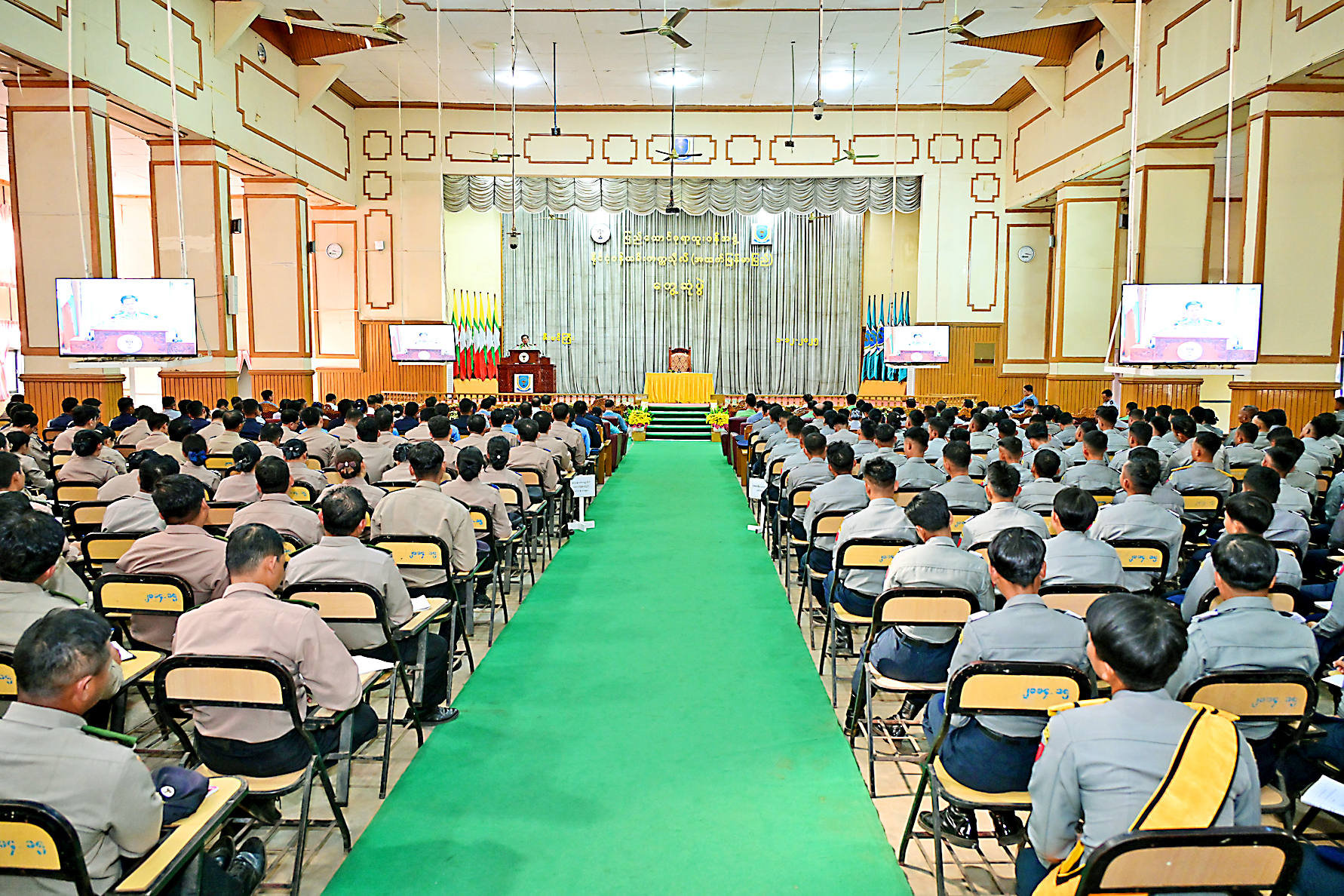
Acting President of the Re-public of the Union of Myanmar and Chairman of State Security and Peace Commission, Senior General Min Aung Hlaing met instructor officers and trainees from the Civil Service Academy (Upper Myanmar), the Police Officer Training Depot (Zeebingyi) and the Central Fire Services Training School (PyinOoLwin) in Zeebingyi of PyinOoLwin Township in Mandalay Region at the Yadana Hall of the Civil Service Academy (Upper Myanmar) this afternoon.
Also present at the meeting were Commission Secretary Joint Executive Chief General Ye Win Oo, Union ministers, the Mandalay Region Chief Minister, senior military officers from the Office of the Commander-in-Chief, the commander of Central Command, rectors, principals, professors, chiefs of divisions, instructors, trainees and officials from the Civil Service Academy, the Police Officer Training Depot, and the Central Fire Services Training School.
On the occasion, the Senior General delivered a speech. He said: Trainees from three training schools came to receive the necessary guidance. These training schools are designed to cultivate competent civil servants, with the understanding that good civil servants lead to a good nation. In any country, governments set policies and civil servants implement them. While political leadership within the government may change, civil servants continue to carry out their duties according to their responsibilities. Even if policies differ depending on the ruling party or government, the functions of offices and departments remain unchanged.
All the trainees applied for and were selected as civil servants, and thus have earned the privilege of serving as government employees. As chosen civil servants, they should not live ordinarily but strive to be competent, high-quality civil servants and work diligently to improve their own lives. Since everyone desires progress and a better standard of living, effort and dedication are necessary. Trainees must consistently put in effort throughout the entire duration of their courses. Training schools, for their part, invest significant time and financial resources to train highly competent civil servants. Therefore, trainees should value and actively learn from everything taught during their training.
Civil servants have to accurately understand the political changes occurring in the country. Due to irregularities in the 2020 general election under the multi-party democratic system, Tatmadaw had to perform their duties according to the Constitution (2008). Throughout the country’s history, various political systems have been implemented, and since 2010,
the nation has followed the path of multi-party democracy that
the public has desired. Tatmadaw is an integral part of the State, and its members emerge from the people themselves. Therefore, Tatmadaw has carried out step-by-step measures to follow the path of multi-party democracy desired by the public. Tatmadaw has also led efforts to address political challenges and difficulties faced by the State. It is important for the trainees to thoroughly study and understand the historical political developments experienced in the country.
The independence and sovereignty of the State are fundamental aspects that must be safeguarded across generations. Independence was achieved only through arduous struggle. Politically, Myanmar is situated between two powerful nations and has a complex historical-political background. Differences in the East and West, internal armed conflicts, and the ongoing need for political stability mean that failure to maintain stability could lead to the collapse of the nation. Therefore, the trainees must learn from the historical experiences of the country to build a modern, developed, stable, and peaceful nation in the future.
Civil servants must have a broad and thorough understanding of political changes. Before and post-independence periods, there were rivalries between the socialist system and the capitalist system. Due to the colonial administration’s divide-and-rule policies and political-ideological differences, armed conflicts among ethnic groups occurred. Even after independence, there were armed conflicts and ideological differences in economic systems. Weaknesses in the management of
the socialist system led to economic decline and crises, bringing the country to the brink of governmental collapse. In September 1988, when the existing government had to suspend its operations, Tatmadaw intervened to maintain and take responsibility for the country. After assuming that responsibility, Tatmadaw work-ed to guide the nation along the multi-party democracy path.
During the 2020 general election under the multi-party democratic system, due to the lack of legal resolutions when electoral irregularities occurred, Tatmadaw had to perform the country’s duties in accordance with the 2008 Constitution. From 2021 until the present, during their tenure, political armed conflicts, political blockades, natural disasters, and various difficulties and challenges were overcome through the collective strength of loyal civil servants and responsible citizens.
In a democratic country, elections are extremely important. Therefore, the multi-party democratic general election will be held on 28 December. In preparation for this, measures have already been taken to ensure that the election is free, fair, and conducted with integrity.
The election process will be carried out in three parts according to the security situation of the nation. Measures have also been arranged to allow voting through the Myanmar Electronic Voting Machines (MEVM), ensuring that no electoral fraud can occur. When casting their votes, trainees should choose those who can act in the best interests of the country and regions, uphold Our Three Main National Causes, and work in harmony with Tatmadaw, which is the most stable and enduring institution of the State.
Regarding the economy, if we review the economic systems practiced over time, there were persistent trade deficits, which were covered by funds obtained from non-trade sources. During the two-term tenure of the democratic governments, trade deficits also existed, and the non-trade funds included foreign loans and financial aid. Only by supporting domestic production could goods be generated, and exports increased. Therefore, during their service to the nation, efforts were made to reduce trade deficits by promoting domestic production. Producing goods is necessary to have the exports needed for trade, and obtaining these exports ensures the foreign currency required by the State, which in turn reduces trade deficits.
Due to the imbalance between demand and supply, foreign currency exchange rates have risen. Therefore, if domestic production can sufficiently meet local needs and surplus products can be exported ab-road, it will bring significant benefits to the country. In producing goods, it is necessary to focus on products based on existing domestic agriculture
and livestock to enhance output. If essential consumer goods can be produced domestically to meet local demand, it will reduce the use of foreign currency spent on imports. Thus, producing sufficient domestic food-stuff instead of importing them will significantly lower foreign currency expenditures.
The purpose of taking the time to explain in detail like this is to help understand the political changes and the economic situations that have occurred in the country. Trainees have spent time, money, and effort to attend these courses, so it is necessary to genuinely learn
and master the knowledge during your training. After completing the training, when it comes time to fulfill your responsibilities in building the future of the nation, trainees should take lessons from past events and apply them in the best possible way.
After the meeting, the Senior General and party cordially greeted the trainees.