
Nay Pyi Taw December 13
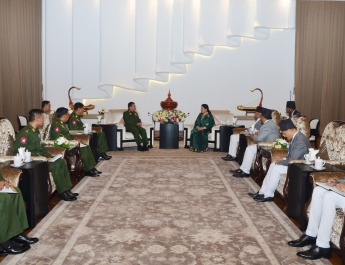
Chairman of State Security and Peace Commission Commander-in-Chief of Defence Services Senior General Min Aung Hlaing met with offi-cers, other ranks and families of stations under the Yangon Command HQ this morning.
Also present at the meeting together with the Senior General were wife Daw Kyu Kyu Hla, Commander-in-Chief (Navy) Admiral Htein Win and wife, Commander-in-Chief (Air) General Tun Aung and wife, senior military officers from the Office of the Commander-in-Chief and wives, and the Yangon Command commander.
Political developments of the country
In his address, the Senior General said the Tatmadaw has to shoulder the duties of the State in accord with the 2008 Constitution because of vote rigging at the 2020 election. At the initial period of the Tatmadaw’s assumption of the responsibilities, demonstrations and armed violence took place to a certain degree, and Yangon Region faced them the most. During that time, COVID-19 pandemic was occurring in the country. The Tatmadaw could solve the problem of disturbances and demonstrations through careful measures, and later, disturbances, and acts of violence decreased. At the time when acts of violence and disturbances were occurring, the country faced hardships when civil servants, including those from education and health sectors, took part in DCS activities, under the outside influence, instigations and threats and coercion, without the ability to clearly differentiate between politics and nation affairs. After 2023, the degree of COVID-19 infection declined, alongside the reduction in the acts of violence and disturbances. But the cyclone Mocha brought destruction to Rakhine State, so, senior military officers were assigned with the duties to carry out rehabilitation and reconstruction at the earliest time, and they could complete the work within six months.
Due to political disagree-ments and instigations, illegal groups, CRPH and NUG, and their subordinate, the terrorist organization by the name PDF, appeared. EAOs provided them with terrorist training. Instead of solving the political problem through political means, violent methods were applied.
History tells us the anti-internal insurgency operations of Tatmadaw during the independence struggle and early post-independence period. Officers, other ranks and families should read the true historical facts to have knowledge of the Tatmadaw. They will know the reason behind the Tatmadaw’s involvement in the national political sector, if they know the history correctly. The Tatmadaw had to safeguard the national sovereignty with all its might when it was threatened by internal armed conflicts that broke out due to political and ethnic disagreements at the early post-independence period. The Tatmadaw has been constantly paying serious attention to “non-disintegration of the Union, non-disintegration of national solidarity and perpetuation of sovereignty” throughout the successive governments and political systems of the successive periods.
The country adopted a parliamentary system after regaining independence, and later, exercised centralized socialism, which had advantages and disadvantages. Myanmar’s adopted system was “Myanmar way to socialism.” Resulting from the single party system under the centralized socialism and planned economy, discontent appeared among the people who lost political exit, or economic exit, and favoritism towards party members in the administrative sector had also caused dissatisfaction. In addition, economic sanctions also hurt the national economy. In fact, weakness in materializing the system outweighed the system’s weakness. Till now,there are countries achieving success under socialism.
Economy is the core of a country’s continued existence. It will be politically strong and will gain development, only if its economy is strong. The national economy was in a downturnunder socialism due to weakness in administration, economic sanctions, emergence of a black market, illegal extraction and export of natural resources, and weather irregularities that triggered the 1988 disturbances, which created an unavoidable situation for the Tatmadaw to assume the responsibilities of the State. The Tatmadaw is a part of the nation, and the Tatmadaw members also are a part of the people. Hence, it laid the foundation of the road to multi-party democracy as aspired by the entire public in 1988, and later, took steps towards the multi-party democracy. It held the multi-party democracy election in 2010 and put the country on the road to the said system. In 2011, during the first term of the democracy government under the leadership of U Thein Sein, reforms were made to be aligned with the new system. The Tatmadaw, on its part, worked in harmony with the government.
Although the first democratic government led by President U Thein Sein made every effort, using all available capabilities, to promote national development, there was a lack of full adaptation to democratic practices. In addition, certain organizat-ions engaged in incitement by stirring up sentiments over past events that had occurred in the country. It was learned as a lesson that grievances arising during the period when the socialist system was practised were carried over into the period of democratic governance, with the past and present becoming intertwined and giving rise to opposition activities.
Subsequently, the NLD party won in the 2015 general election and assumed the responsibilities of the State as the second democratic government. While the public had high expectations of them during their tenure, weaknesses in administrative experience and actions opposing some policies of the previous government caused certain economic shortcomings.
In the first two years of assuming office, the country received substantial foreign assistance, which strengthened the economy. Later on, the national economy declined due to continued weak management, reliance on foreign aid for economic operation, lack of domestic economic support, absence of local production, and the implementation of foreign advisors’ recommendations that did not align with the country’s actual conditions. These operational and managerial weaknesses
also led to reduced public confidence in the government, causing concerns about whether the NLD could secure victory in the 2020 election. During the election, there were observed instances of electoral irregularities.
Regarding the widespread discrepancies in the voter lists, the Tatmadaw repeatedly in-formed the relevant government authorities to investigate and take action. However, no resolution was made, and preparations to convene the Hluttaw attempted to seize State power unlawfully. As a result, the Tatmadaw was compelled to de-clare a State of emergency and assume the responsibilities of the State in accordance with the 2008 Constitution. While carrying out these responsibilities, the country faced numrous challenges, including poli-tical unrest and violent actions arising from differences in poli-tical views, territorial expansion and profit-seeking by armed ethnic groups, the COVID-19 pandemic, cyclones, floods, and other natural disasters, as well as significant damage caused by the massive Mandalay earth-quake. Despite these difficult-ies and crises, the Tatmadaw undertook efforts to maintain national stability, peace, and development.
Everyone needs to strive to hold a free and fair multi-party democratic general election successfullyAs elections are the most im-portant aspect of the democratic system, all necessary preparations have been made to ensure the successful conduct of a multi-party democratic election, including the 2024 population and household census. In the coming weeks, everyone will need to work together to ensure that a free and fair multi-party democratic general election can be successfully held. When casting votes, it is necessary to select individuals who can genuinely act in the best interest of the nation and the regions, who possess political, administrative, economic, security, and rule-of-law perspectives, and who can cooperate closely with the Tatmadaw, which has existed strongly and steadfastly since the achievement of independence. These individuals must also uphold the Our Three Main National Causes, be knowledgeable about the law, and act accordingly. The Tatmadaw is an organization that has loyally served the State and the nation across generations. The Hluttaw is responsible for legislation and, under the 2008 Constitution, must oversee executive, legislative, and judicial powers of the State mutually. It is also necessary to revise or repeal laws that could harm national interests in accordance with the law. Legislators must have legal knowledge to carry out legislative duties properly. Therefore, those intending to compete as Hluttaw candidates must possess an appropriate level of education. It is stipulated that they should have at least completed university entrance-level studies. Practising democracy requires knowledge of the law, and since students completing KG to Grade 12 will reach voting age (18 years), they are eligible to vote. Consequently, legal knowledge is being taught to students currently attending KG–Grade 12.

Development of the State economy
Regarding the economy, during the time of the current government, there were economic sanctions, and foreign assistance decreased significantly. In addition, the government had to take measures to repay remain-ing debts owed to foreign countries. Efforts were also made to increase domestic product-ion and enable exports abroad.
In developing production-based industries that rely on agriculture, it is necessary to ensure the accuracy of basic statistical data. The lack of reliable information over time has harmed the nation’s economic interests. If agricultural activities achieve their target yield per acre, more agricultural products can be exported, potentially generating an additional approximately US$-8 billion in revenue.
For national development, all residents of the country must work together, and each individual must genuinely perform their role within their respective sectors. Welfare of Tatmadaw personnel and enhancing capabilitiesBenefits for Tatmadaw personnel and government employees have been increased as much as possible. Measures have been taken to provide appropriate benefits including food, shelter and clothing of all Tatmadaw personnel. Each personnel is urged to exercise self-restraints on beverages, pleasure and food that are not beneficial for them. Striking the balance between incomes and spending can enhance welfare and it is necessary to strike incomes and spending and to distinguish between the necessary spending and wasteful spending. The Tatmadaw has taken measures for welfare of personnel and if manageable agriculture and livestock breeding tasks are carried out, this will contribute a lot to welfare. Consistent efforts must be made for striking the balance between incomes and spending.
As the Tatmadaw is a strong institution for national defence, it is necessary to be always fit for fight. As each personnel is required to be fit and healthy, brave and competent, daily tasks must be carried out correctly according to the procedure. All personnel have been systematically trained for necessary warfare according to their ranks and so it is necessary for them to apply military tactics correctly. It is also necessary to handle weapons and equipment skillfully. As for lifestyle, it is important to exercise consciousness and mindfulness and as the Tat-madaw is required to possess necessary defence capabilities for the country, the government has provided arms, aircraft and helicopters and warships and individual personnel are requir-ed to enhance their capabilities.
To build better, developed future country
During the assumption of State duties, we have performed duties by overcoming various hardships and the ultimate objective of holding a multi-party general election successfully will be achieved soon.The government has many tasks to be carried out and it has successfully overcome the first page. After the election, the second page will be opened. And it is necessary for all to cooperate to build a better and more developed country in the future.
Then, the Senior General asked for and attended to the needs of officers, other ranks and families.
Then, the Senior General presented foodstuffs for officers, other ranks and families to the regional command commander and the wife of the Senior General presented cash assistance for the maternal and child welfare association to the wife of the commander.
After the meeting, the Senior General and his wife and party cordially greeted the officers, other ranks and families.