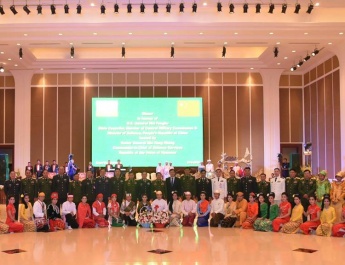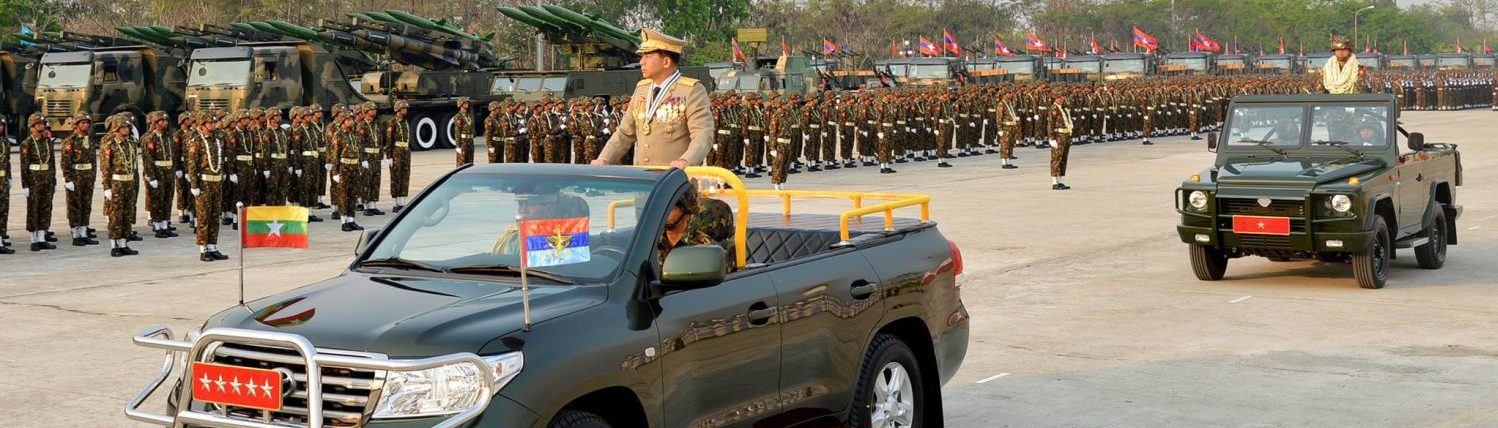
It is necessary to preserve the noble legacy and continue to uphold and enhance the prestige of the Tatmadaw and the nation
Nay Pyi Taw March 13
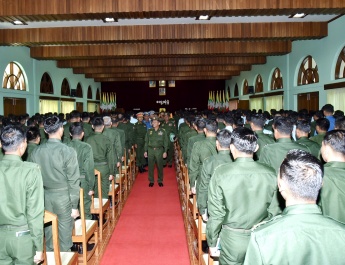
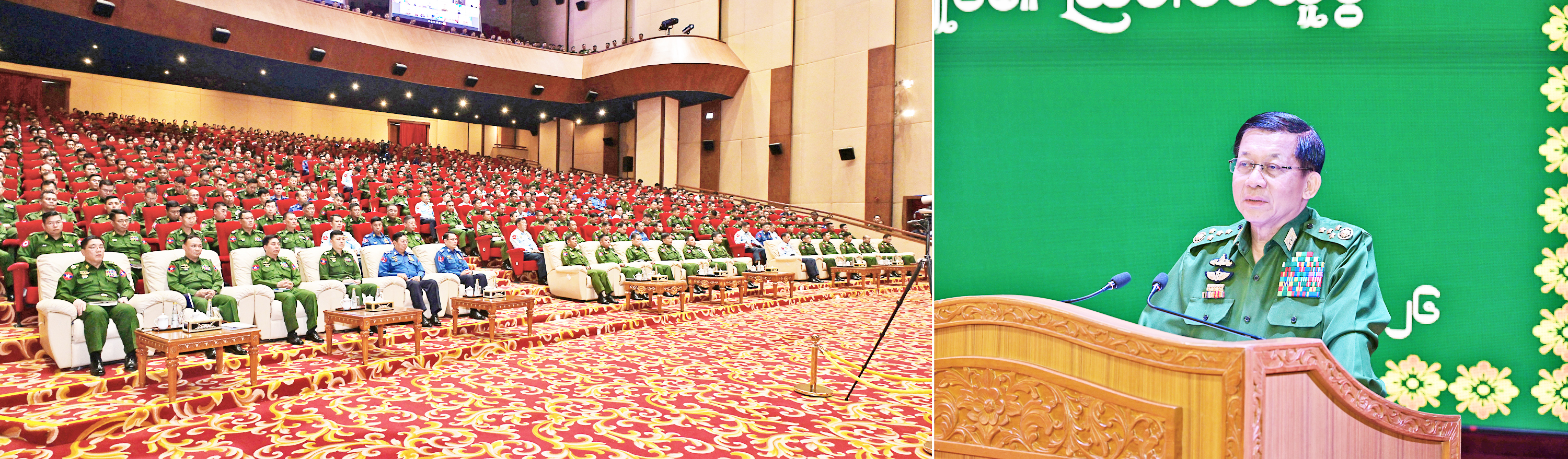
Chairman of the State Security and Peace Commission Commander-in-Chief of De-fence Services Senior General Min Aung Hlaing reviewed the endeavours to shape the Tatmadaw to be a modern one from 2011 to 2025 and gave guidance at the Thabin Hall of Zeyathiri Beikman in Nay Pyi Taw this afternoon.
Also present at the meeting were Commission Vice Chairman Deputy Commander-in-Chief of Defence Services Vice-Senior General Soe Win, Com-mission Secretary Commander-in-Chief (Army) General Ye Win Oo, Commission member Chief of the General Staff (Army, Navy and Air) General Kyaw Swa Lin, Commander-in-Chief (Navy) Admiral Htein Win, Commander-in-Chief (Air) General Tun Aung, senior military officers from the Office of the Commander-in-Chief, officer and other ranks together with commanders of relevant military commands, commanders of relevant military headquarters of Tatmadaw (Army, Navy and Air) and commander of operation commands through the video conferending.
Serving duties of Commander-in-Chief of Defence Services and efforts to build a modern Tatmadaw
Speaking on the occasion, the Senior General said that this meeting aimed to review and discuss, from his perspective, the efforts made since 2011 to modernize the Tatmadaw and the measures that need to continue, as well as to receive guidance on what is required going forward. From his standpoint, he began serving as Commanderin-Chief of Defence Services on 30 March 2011, at a time when the country had just started moving along a multi-party democratic path.
After being entrusted with the responsibilities of Commander-in-Chief of Defence Services with the full confidence of heads of the Tatmadaw, he has strived to perform these duties to the best of his ability. During this period, he combined the guiding principles and directives of the previous heads of the Tatmadaw with his own experiences to execute my responsibilities effectively. He has continuously focused on the development and modernization of the Tatmadaw, enhancing its capabilities, and fostering strong relations with foreign militaries to ensure the Tatmadaw’s excellence.
The primary duty of the Tatmadaw is national defence against external threats, and historically, it has also been responsible for managing internal armed conflicts. Previous heads of the Tatmadaw consistently carried out their responsibilities to serve the best interests of both the State and the Tatmadaw. He is
the eighth Commander-in-Chief of Defence Services, and, following the example of his predecessors, he has organized and developed the Tatmadaw with the goal of creating a capable, combat-ready, and modern standard army able to fully perform the nation’s defence responsibilities.
Implementation and enhancement of military staff functions
The Commander-in-Chief of Defence Services who served throughout the eras undertook tasks with all available forces within the military to achieve the cessation of internal armed conflicts, conduct counter-in-surgency operations, and repel foreign invasions. They carried out major operations capably, such as suppressing the insurgency of the Communist Party of Burma (CPB) and repelling the invasion of the Chinese Kuomintang. During my own tenure in the military, from my time as a junior officer to a senior officer, I served for extended periods in combat battalions and units, undertaking national security and defence duties, and successfully fulfilled all assigned responsibilities.
In building the military into a modern armed force, it is necessary not only to upgrade infantry battalions and units but also to enhance the capabilities and strengths of the Navy, the Air Force, and the various service corps. During my time as Commander-in-Chief of Defence Services, beyond upgrading the personnel and weaponry organization of the (Army, Navy and Air), I was able to arrange for the construction of necessary naval vessels for the Navy ourselves, as well as their procurement. For the Air Force, I oversaw the upgrading and production of necessary aircraft and helicoters, and worked to acquire modern aircraft and helicopters. Furthermore, based on experiences gained through success-ive eras, we undertook the procurement and indigenous pro-duction of not only necessary weapon systems but also other related equipment for the per-sonnel of the Army, Navy, Air, and service corps.
During my tenure as Commander-in-Chief of Defence Services, to productively utilize the nation’s female workforce, we began permitting women to enlist for military service starting in 2014. Previously, women in the military were only appointed as doctors and nurses in the medical corps. Subsequently, we have recruited women for graduate officer courses, computer diploma courses for sergeants/corporals/clerk ranks, female nursing courses, and basic military training courses, thereby productively harnessing the human resource potential of women. Currently, over 5,000 women (officers and other ranks) are capably undertaking national defence duties on par with men. A remarkable and praise worthy achievement is the successful training of female pilots and aviators.
Furthermore, to ensure the nation possesses a respectable defence capability and security strength, the People’s Military Service Law, which had existed since 1959 and was revised in November 2010, was activated and brought into force on 10 February 2024, and its implementation has been carried out.
People’s military service personel are now participating in national defence duties from their respective positions, sacrificing their lives and efforts. We must recognize their service to the nation and continue to work to ensure they receive necessary support and entitlements.
In my efforts to build the military into an internationally standard force, I continuously endeavoured to achieve self-sufficiency in the production and use of weapons and military equipment. In establishing a Standard Army, beyond upgrading the personnel and weaponry organization of the Army, Navy, and Air, I was able to arrange for the construction of necessary naval vessels for the Navy ourselves, as well as their procurement. For the Air Force, I oversaw the upgrading and production of necessary aircraft and helicopters, and worked to acquire modern aircraft and helicopters. Additionally, I was able to establish a ceremonial Mounted Cavalry Unit, which now participates splendidly in military parades and national-level ceremonial welcome events.
Advancements in military welfare
I also made efforts to enhance the educational standards of Tatmadaw members by opening Defence Services Educational Schools, enabling service members lacking formal education to attend classes and achieve higher educational levels. Through these Defence Services Educational Schools, I was able to implement measures ensuring that all serving personel received education at least up to the primary level. Just as I worked to enhance the education of serving personel, I also emphasized and implemented measures to im-prove the educational standards of both serving and retired Tatmadaw members and their families.
From 2011 to 2025, to improve the education of children from veterans’ families, we provided monthly stipends, educational support allowances, and scholarships according to the academic year. Furthermore, starting from the 2011-2012 academic year, annual awards were presented to children of serving personnel, veterans, and civilian equivalent employees who passed with Distinctions (3 or more subjects), to personnel who passed with at least one Distinction or achieved academic excellence, to winners of essay, composition, art, and cartoon competitions (first, second, third), and to principals from Defence Services Educational Schools with the best examination results. Regarding the number of awards presented from the 2011-2012 academic year to the 2024-2025 academic year: there were 487 students with 6 Distinctions, 962 with 5 Distinct-ions, 1,508 with 4 Distinctions, 1,980 with 3 Distinctions, 2,759 with 2 Distinctions, and 9,404 with 1 Distinction, totalling 17,100 distinction recipients. From 2013 until 2025, I also arranged annual overseas study tours for all-round excellence award winners, those who obtained 5 or 6 distinctions, those who achieved the highest marks, and two headmasters from Defence Services High Schools and Educational Schools. Up to now, 271 students have been sent on these tours.
For Tatmadaw members who became disabled during their service for national defence, for the families of those who died or were killed in action, and for retirees who have completed their service, we were able to construct veterans’ housing projects in various regions to ensure they could live well.
Across the areas of different Regional Military Commands, there are 21 sites for high standard/affordable veterans’ housing projects. As of 31 December 2025, over 6,800 housing units have been completed, over 4,000 units are under construction, and arrangements are being made to allocate a further 870 units.
He stated that during his tenure as Commander-in-Chief of Defence Services, new military hospitals were expanded, and necessary medical equipment was provided for the health and fitness of service personnel and their families. He noted that to provide basic healthcare to the public, military mobile medical teams were dispatched, and the river-going hospital vessel(Shwe Pazun) and the sea-going hospital vessel (Thanlwin) were deployed to provide treatment. He highlighted that healthcare services for both military personnel and the public’s basic health needs have been carried out more extensively since 2011. Furthermore, he remarked that the warm welcome and trust shown by local people toward the military mobile medical teams serve as invaluable proof of Tatmadaw being a force the people can rely upon.
Furthermore, he stated that he has awarded honorary titles, medals, and certificates to military personnel and their families who served the nation and the military with selflessness and outstanding dedication, providing them with the honors they deserve. He noted that from 2011 to 2025, a total of over 110,000 officers and soldiers were presented with these honorary titles, medals, and certificates.
Regarding logistics
He stated that to ensure military personnel and their families can live comfortably, housing and apartment units were con-structed according to their respective ranks, and indoor gymnasiums and standard football fields were also built at units, regiments, and headquarters. Regarding logistics and transport, he noted that military-owned locomotives and railway carriages were provided to facilitate the smooth transport of military goods and to ensure convenient travel for service personnel and their families, thereby establishing a military railway system. Furthermore, he added that the allowance for fresh rations for military personnel was also increased. He also stated that the necessary motor vehicles for the military were provided and that efforts were made to ensure that all personnel from the Army, Navy, and Air could wear standard uniforms appropriate to their respective regions and duties. He noted that to improve the clothing and appearance of military personnel, military textile and garment factories were upgraded and opened, and as a result, significant improvements in their uniforms and attire can now be seen. He added stated that the military raincoat factory, military leather factory, and military textile and garment factories were up-graded to produce high-quality equipment, including boots and other necessary items for service personnel. Between 2011 and 2025, 193 new types of uniforms were expanded for the entire Army, Navy, and Air, including 26 sets of ceremonial uniforms, 30 sets of combat uniforms, 25 sets of cadet uniforms, and 28 sets of work uniforms.
Regarding the upgrading of the Tatmadaw (Navy) and Tatmadaw (Air)
He stated that in building a modern military, it is necessary to be both strong in power and sharp in capability. Therefore, in addition to infantry units, he carried out upgrades for the Tatmadaw (Navy) and Tatmadaw (Air). Regarding the Navy, he noted that during his tenure as Commander-in-Chief of De-fence Services, naval vessels required for the Navy were successfully built locally and commissioned, while additional vessels were also acquired and supple-mented from foreign countries. In carrying out these efforts, the submarine force was also expanded, and the submarines UMS Minye Theinkhathu and UMS Minye Kyaw Htin were successfully commissioned into service. He noted that it is the only military in the region capable of independently designing and constructing naval vessels at its own military shipyards. Furthermore, he stated that the recently commissioned frigate, UMS King Thalun, is the largest vessel among those built locally using the country’s own designs. He stated that since these naval vessels could be constructed locally, the country would be able to better dominate and protect its maritime territory. He noted that the successful upgrading and reorganization of Tatmadaw (Navy), along with the enhancement and replenishment of vessels, has allowed for improved monitoring and protection of maritime interests and security. He added that it is necessary for every individual sailor to continue working toward the systematic handling and operation of the weaponry and equipment they use to ensure the security of the nation’s territorial waters and the protection of maritime interests.
The Senior General said that during his tenure the Tatmadaw (Air) had replenished the air-crafts and helicopters required for its operations. In this process, transport aircraft and helicopters, as well as attack aircraft and helicopters, were replenished on an annual basis. The aircrafts and helicopters acquired this time are modern platforms with capabilities comparable to those used by international air forces. The Tatmadaw (Air) has also been able to train and produce pilots with strong individual capabilities. As human resources are essential for a modern air force, efforts have been made to up-grade and train pilots, engineers and professional soldiers, including through the use of simulators for each aircraft type to strengthen training capacity. The Senior General added that the Tatmadaw (Air) should continue striving to utilize the air-crafts and helicopters it has acquired to enhance combat capability and operational power, while also contributing to national and public welfare.
Training, administration, and efforts to enhance welfare and morale
Training is a fundamental requirement in building a capable military. Regardless of how powerful the weapons may be, they will not be effective if the officers and other ranks responsible for operating them lack the necessary skills. Therefore, in accordance with the motto “study, practice, and apply,” every soldier must continuously learn, conduct regular training, and
put into practice the knowledge and skills they have acquired. During his tenure as Commander-in-Chief of Defence Services, joint military exercises involving the Army, Navy, and Air were successfully conducted. As this is the era of advancing technology, joint exercises that are relevant to modern conditions must continue to be carried out. In addition, alongside expanding and strengthening training for the Tatmadaw (Army, Navy, and Air), military academic institutions have also been upgraded to enable the conferral of advanced doctoral degrees in military and related studies.
In terms of administration, there must be balanced and fair governance, supported by effective management and strict ad-herence to military discipline. Administrators should demonstrate strong leadership and a sense of responsibility toward their subordinates, ensuring sound command and administration. They must also ensure that each soldier has adequate living conditions and food, and that all entitled rights are fully enjoyed. At the same time, they should do their best to help re-solve the personal difficulties and challenges faced by soldiers.
Regarding welfare, it is not only about providing money, equipment, and food to ensure comfort, but also about ensuring that subordinates have convenient living conditions, transportation, education, and healthcare. It is stated that promotions in
the Tatmadaw are granted based on length of service and the skills acquired during military service. Monthly allowances are also provided. To improve the living conditions of military personnel, the monthly allowance of Ks-30,000 was increased three times between 2023 and 2025. In addition, special allowances have been granted to military personnel and members of the Myanmar Police Force who are carrying out national defence and security duties, based on their years of service. The Tatmadaw is making efforts to provide for the welfare of military personnel and their family members as much as possible. At the same time, it is important to understand the difference between necessary spending and waste when considering individual welfare. Avoiding unnecessary food and drink can also help reduce personal financial expenses.
Regarding morale development, all members of the Tatmadaw should cultivate a strong sense of patriotism and firm belief, and regard the three main national causes upheld by the Tatmadaw as their own national responsibility. Sports competitions among the Tatmadaw (Army, Navy, and Air), as well as competitions at the levels of regional commands, battalions, and units, are also organized, with the aim of strengthening morale through sporting activities. Efforts should also be made to foster a sense of love for the army, loyalty to one’s unit, and pride in the Tatmadaw. The Tatmadaw will continue to exist as long as the state exists. As expressed in the saying that “the Tatmadaw is the mother and father of the people,” unity and strength must be built. Every Tatmadaw member should possess the fundamental spirit of safeguarding the state, take pride in having joined the Tatmadaw voluntarily, and having served with dedication and sacrifice, and strive to become dependable soldiers whom the state and the Tatmadaw can rely upon.
In the arena of international relations, while performing duties as the Commander-in-Chief of Defence Services between 2011 and 31 January, 2021, made 53 international goodwill visits to 24 countries and studied the building tasks of a modern army during the visits, managing to upgrade the Tatmadaw. Similarly, since the assumption of the duties of the Head of State in February, 2021, I made 12 visits to six countries and was able to promote defence cooperation.
Officers and other ranks from the Tatmadaw were also sent on 2,892 international visits including international scholar-ship tours, international joint military exercises, forums related to armed forces and goodwill visits, allowing over 7,000 officers and more than 700 other ranks to participate in them. They were sent there to increase engagement with international armed forces and to gain inter-national experience.
Governments are elected and will be changing over the designated tenures but the Tatmadaw, unlike governments, will not change and shoulder the duties handed down on it. During the assumption of the duties of the Commander-in-Chief of Defence Services for 15 years, relentless efforts were exerted to make it the only patriotic army, which is strong, capable and modern.
The Tatmadaw is mainly responsible for non-disintegration of the union, non-disintegration of national unity, perpetuation of sovereignty and safeguarding the state constitution. Therefore, all Tatmadaw personnel are solemnly urged to continue to improve the image of the Tatmadaw and the country by preserving the noble legacy adopted prudently and handed down by successive leaders of the country.
Then, the Senior General spoke words of appreciation and honour to Vice Chairman of the commission Deputy Commander-in-Chief of Defence Services Vice-Senior General Soe Win for his concerted cooperation in the interests of the Tatmadaw and the country during the 15-year period of assumption of duties of the Commander-in-Chief of Defence Services by the Senior General.